


- What will shape coworking over the next 5-10 years?
- How will coworking business models evolve?
- What should business owners do now?
Q: What will define coworking over the next 5–10 years, and how can business owners benefit right now?
A: Hybrid work, healthier certified buildings, AI-driven operations, and owner–operator models will make flex space more available and cost-efficient. Combine a virtual office address, on-demand meeting rooms, business phone, and live receptionist to gain a real office presence without the overhead of a lease.
Modern work is constantly evolving, and coworking is evolving with it.
The future of coworking will be shaped by hybrid work, growing corporate demand, healthier buildings, and smarter technology – bringing more choice and better value for business owners who need flexibility without waste.
Below is a clear, data-backed view of what to expect over the next 5–10 years, and how to use these trends to your advantage.
Unlock Our Current Virtual Office Offers
Enter your email below and we’ll send you the latest available promotions and monthly specials for Virtual Offices, Meeting Rooms, and Live Receptionists.
What Will Shape Coworking Over the Next 5-10 Years?
- Hybrid Work Solidifies its Place
Hybrid isn’t a passing trend; it’s the operating model for many companies. Large occupiers are now planning around fluctuating attendance, adopting desk-sharing, and using tools to make space planning predictable. This shift fuels ongoing demand for flexible, on-demand workspace rather than long, inflexible leases.
What it means for you: More locations near home or clients, shorter commitments, and smarter tools to book exactly what you need.
- Flex Takes a Bigger Share of Office Portfolios
Analysts agree: flexible space is on track to make up a much larger share of total office inventory by 2030. More landlords are integrating flex space directly into their buildings and portfolios.
What it means for you: A wider range of price points, locations, and brands, so you can optimize for cost, commute, or convenience.
- Corporate Coworking Gains Momentum
Enterprises are rebalancing toward smaller HQs plus flex. Operators are adopting asset-light models and partnering with landlords, which is improving stability and quality across the sector.
What it means for you: Better service standards, clearer SLAs, and enterprise-grade amenities filtering down to SMEs.
- Operators Get Leaner, Models Mature
Headlines about closures signaled a reset – not a collapse. Operators have shed unprofitable sites, renegotiated leases, and strengthened balance sheets. WeWork’s restructuring is one example of the market recalibrating for long-term health.
What it means for you: A more stable marketplace with stronger operators and fewer weak locations.
- Management Agreements Outpace Leases
Landlords are increasingly favoring revenue-share and management agreements over traditional leases. These models reduce operator risk and allow landlords to capture more upside. In the UK, such deals jumped from 9% pre-2020 to around 41% in 2024 – a trend now spreading worldwide.
What it means for you: More building-branded flex space and deeper integration of amenities.
- Wellness Becomes the Standard
Certifications like WELL and Fitwel are quickly moving from nice-to-have to baseline expectations as employers prioritize health, retention, and productivity.
What it means for you: Better air quality, lighting, acoustics, and biophilic design. These often come with measurable certifications you can share with clients and team members.
- Smart Buildings + AI Optimize in Real Time
Sensors and AI are shifting from pilot projects to standard practice. This enables dynamic capacity planning, automated climate control, predictive maintenance, and usage-based pricing.
What it means for you: Smoother bookings, fewer bottlenecks, and more value from every hour you pay for.
- On-Demand Networks Go Mainstream
Aggregators and networks are linking thousands of spaces under single booking interfaces – ideal for distributed teams and frequent travelers. Partnerships and acquisitions are accelerating coverage and capabilities.
What it means for you: One-tap access to desks and meeting rooms in nearly any city.
- Niche and Community-Led Spaces Grow
From child-friendly spaces to women-focused clubs and industry-specific labs, niche operators are gaining traction. Clear identity drives loyalty and revenue resilience.
What it means for you: Easier to find a space that fits your culture and your clients.
- Sustainability Becomes Measurable (and Expected)
Members and investors are demanding verifiable ESG performance: recycled fit-outs, circular furniture, low-carbon operations, and published metrics.
What it means for you: More transparently sustainable choices, often with efficiency savings built in.
- Global Growth, Local Convenience
Flex is expanding fastest in high-growth markets like India’s tech hubs, while suburban and secondary US markets keep adding sites to serve hybrid commuters.
What it means for you: Shorter commutes, more neighborhood options, and easier client coverage.
- Community Still Wins
Human connection remains coworking’s differentiator. Helpful onboarding, inclusive events, and thoughtful touches turn occasional visitors into loyal members – especially in virtual office contexts.
What it means for you: Choose providers that invest in people, not just square footage.
NEXT STEPS: The Future of Coworking: Trends, Reviews & What to Look for in Your Next Workspace
How Will Coworking Business Models Evolve?
Greater membership flexibility
Expect modular plans that can be layered to create even more flexibility.
For example, combine a business address, a phone system, live receptionist, meeting room credits, and day-pass coworking under one subscription, and one provider, which saves working with multiple vendors.
This mirrors how many small businesses already mix virtual addresses, business phone numbers, and flexible on-site meeting room access.
Hybrid firms leverage virtual office addresses
As remote and hybrid firms mature, the “virtual HQ + on-demand rooms” setup grows.
A virtual office address with secure mail handling can be used for licensing, banking, and exploring new markets.
In addition to a recognized address, teams can utilize onsite meeting space on-demand or with pre-paid credits, as needed.
Business support services become standard
Live Receptionists, call routing, booking apps, and compliance assistance are seen as part of the standard setup rather than add-ons – solving two major challenges for small businesses: saving time and building trust.
For many founders, services that protect personal numbers and handle intake calls free up significant time and resources, making it easier to focus on growing the business instead of fielding calls.
Solopreneurs & digital nomads keep growing
The solo economy and location-independent workers continue to be a major driver of flex space demand.
Many look for professional addresses, phone systems, and occasional meeting rooms to legitimize and scale their ventures – and they’re shaping how operators package services.
NEXT STEPS: Smarter Work, Smarter Marketing: How Coworking and Social Media Fuel Small Business Success
What Should Business Owners Do Now?
1) Right-size your workspace mix
Audit your space utilization by day and by team. Replace underused leases with smarter flex options. Most occupiers are already rebalancing portfolios around hybrid patterns – let the data guide your decisions.
Action: Shift recurring meetings to on-demand conference rooms. Maintain a virtual HQ for mail handling, compliance, and consistent branding.
2) Build in health & sustainability into your criteria
Look for WELL/Fitwel certifications, fresh air rates, acoustic privacy, and daylighting. Healthier workspaces aren’t a luxury – they directly support engagement, productivity, and retention.
Action: Prioritize providers with third-party health or ESG credentials. Or look for those with a clear, transparent roadmap.
3) Automate the admin
Safeguard personal numbers, route calls to the right people, and use a live receptionist service to capture leads while you focus on billable work. Small process upgrades can deliver big efficiency gains.
Action: Choose a plan that includes a business number, voicemail-to-email, unlimited extensions, and receptionist coverage.
4) Think membership, not rent
Treat your coworking membership as a flexible toolkit: address, rooms, day passes, phones, reception, and mail handling, which are all adjustable month to month. The right combination scales up or down easily, keeping pace with your clients and your growth.
Action: Treat your coworking plan like software: subscribe, customize, and upgrade only when you need to.
Further Reading :
- Virtual Office vs Coworking: What You Need to Know When Choosing a Working Space
- Why Remote Offices are Here to Stay as America Goes Back to Work
- How to Set Up a Virtual Business Address for LLC
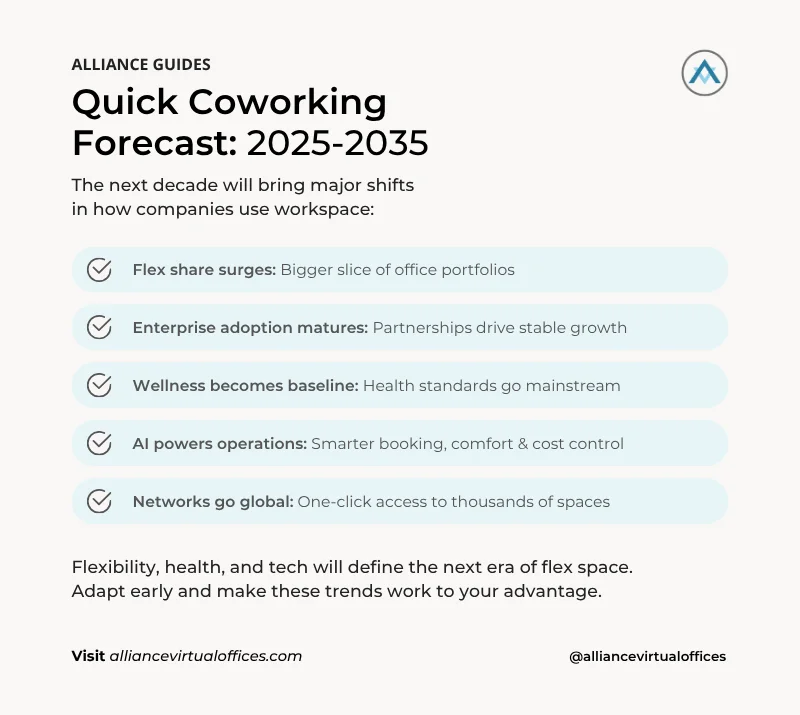
Key Takeaways: The Future of Coworking: Predictions for the Next 5–10 Years
If you’re ready to future-proof your workspace mix, consider a Virtual Office + Meeting Room bundle. Alliance’s Platinum Plus Plan includes a professional business address, secure mail handling, and up to 16 monthly hours of meeting room access.
This means you can keep overhead low while still meeting clients in a fully equipped, private space. Add a Business Phone and Live Receptionist service to protect your time and deliver exceptional service when prospects call.
Alliance makes it easy to combine a professional address with workspace access, a business phone, and a live receptionist service, all in one flexible plan – ideal for solopreneurs, remote teams, and growing firms.


