- What NYC meeting rooms cost
- Meeting Rooms by New York Neighborhood
- What’s Included and How Booking Works
Q: How much does it cost to rent a meeting room in NYC?
A: Most New York City meeting rooms rent for $25 to $160 per hour, with the spread driven by room size, neighborhood, and venue type. Small huddle rooms sit near the bottom of that range. Boardrooms and training rooms sit near the top.
Renting meeting rooms in New York used to mean signing a lease or borrowing someone else’s conference room. Neither option helps when you need a professional space for two hours on a Thursday afternoon.
The city has no shortage of rooms available by the hour. Finding one at a fair rate, in the right district, with video gear that actually works is the harder part.
This guide covers what NYC rooms cost, which neighborhoods suit which meetings, what your rate includes, and how on-demand booking works. Read it before you start calling centers, and you’ll shortlist faster.
How Much Does It Cost to Rent a Meeting Room in New York City?
Meeting room rental NYC pricing typically runs $25 to $160 per hour, depending on venue type and room size. Coworking spaces sit at the lower end, dedicated providers in the middle, and hotel conference rooms at the top. Half-day and full-day blocks usually reduce the effective hourly cost.
Three things move that number. Room capacity comes first, followed by the building’s address, and then whether audiovisual equipment and reception are bundled or billed separately.
Most searches for conference room rental New York land on one of three venue types. Coworking floors are the cheapest and least formal, hotel banquet rooms are the priciest and most variable, and dedicated business centers sit between the two with the most predictable inclusions.
Here’s the useful context: Manhattan’s average office asking rent reached $66.82 per square foot in 2025, with Class A and A+ space at $78.05. Landlord economics like those flow straight into what a center can charge for an hour of conference room rental in New York.
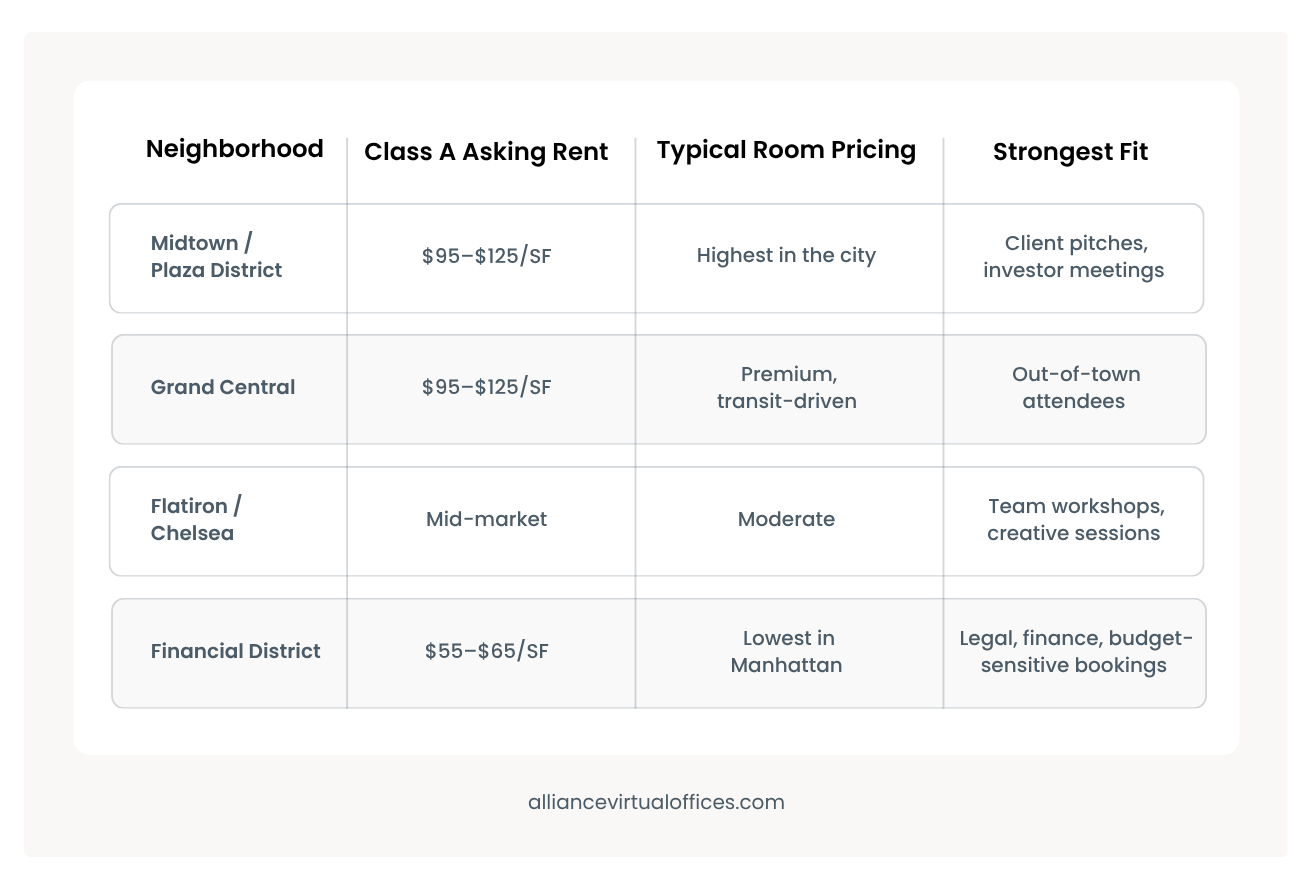
Treat those as planning ranges, not quotes. Published rates in the same building can vary by floor, by day of week, and by how far ahead you book.
If you’d rather skip the shopping-around, Alliance’s New York meeting rooms publish hourly rates upfront across all six neighborhoods covered below.
Hourly vs. Half-Day vs. Full-Day
An hourly meeting room rental makes sense for anything under three hours, which covers most pitches, interviews, and client consultations. Book two hours when you need ninety minutes, because setup and overrun are real.
The half-day rate usually covers three to four hours and beats the hourly math once you cross the three-hour mark. Workshops, board sessions, and back-to-back client days generally belong here.
Full-day blocks are priced for eight hours and suit training, offsites, and hiring loops. If your day includes a lunch break, a full-day booking is usually cheaper than releasing and rebooking the room.
Meeting Rooms by New York Neighborhood
Neighborhood swings conference room rental New York pricing more than any factor except room size. The same eight-person room can cost 40% more on Park Avenue than it does eight subway stops south.
Commercial rents make the pattern easy to read. Class A space in Midtown averages $85 per square foot, while the Financial District runs closer to $62, and hourly room rates track that gap closely.
If you’re searching for meeting rooms near Midtown New York, expect the highest rates in the city and the strongest signal to clients. Midtown centers cluster around Fifth Avenue, Avenue of the Americas, and the Plaza District, where trophy buildings do a lot of quiet persuading before anyone sits down.
One caveat on searching meeting rooms near Midtown New York: the label covers everything from 34th Street to 59th, and rates inside that stretch are not uniform. Rooms west of Eighth Avenue and north of 57th Street usually price below the Fifth Avenue core.
Grand Central is the practical choice when attendees arrive from Connecticut, Westchester, or Long Island. Rooms on Lexington, Madison, and East 42nd Street price at a Midtown premium, and you buy back the time your guests would spend crossing town.
Flatiron and Chelsea land in the middle on both price and formality. These rooms tend to suit product reviews, creative workshops, and investor updates where a slightly less corporate room reads as a feature.
The Financial District is where cost-conscious bookings go. Wall Street and Broad Street addresses still carry weight with legal and finance clients, and the hourly rates are usually the lowest in Manhattan.
Read More: Complete Guide to Booking Professional Meeting Space
What’s Included in an NYC Meeting Room Rental?
The advertised hourly rate is only useful if you know what it covers. At dedicated business centers, the base rate typically includes the room, furniture, Wi-Fi, and a staffed front desk, and that bundling is often why a $75 room beats a $60 one on total cost.
Ask any center for an all-in quote before you confirm. Screens, catering, and after-hours access are the three line items most likely to appear later.
Most professional NYC rooms include:
- Furnished room with conference table and seating
- High-speed Wi-Fi and power at every seat
- Whiteboard or flip chart
- Staffed reception to greet and direct your guests
- Building lobby access and visitor sign-in
- Coffee, tea, and water service
Hybrid and Video-Conference Readiness
Hybrid formats are now standard rather than exceptional. 86% of global workers now attend meetings with at least one remote participant, and 77% of employees rely on video conferencing tools for their team meetings, which means at least one dial-in attendee is the default assumption for most bookings.
A genuinely video-conference-ready room needs four things: a wall-mounted display, a wide-angle camera, a ceiling or table microphone that covers the whole table, and a hardwired connection as backup. Confirm all four in writing, because “screen available” and “video ready” are not the same claim.
You can browse meeting room locations across the city to compare which centers list AV in the base rate. That single filter removes a lot of guesswork.
Everything You Need to Grow Your Business

That’s what you get with a custom
Virtual Office Plan from Alliance
Select:
- Virtual Office
- Live Receptionist
- Virtual Phone
- Meeting Rooms
- Coworking
- Full Time Office
How On-Demand Booking Works
On-demand booking replaced the old process of calling five buildings and waiting for callbacks. Most flexible workspace providers now publish live availability, and the whole reservation takes a few minutes.
Meeting room rental NYC listings now show real inventory across most Manhattan buildings, which is a meaningful change from a few years ago. You can see a room, its rate, and its open hours without speaking to anyone first.
The sequence is consistent across providers:
- Search by city, ZIP code, or neighborhood
- Filter by date, time, and headcount
- Compare room photos, amenities, and hourly or daily rates
- Reserve and pay online, or call to have the booking placed for you
- Receive written confirmation with building access details
The shift toward published pricing has changed how people shortlist rooms, too. A few years ago, comparing five buildings meant five phone calls and five different quote formats, which made price comparison genuinely difficult.
Now that most centers list rates online, you can filter by budget the same way you’d filter a hotel search, and the room that looked expensive on a phone call often turns out mid-range once you see it next to real alternatives.
Cancellation terms deserve a look before you pay. Many NYC venues charge a fee inside 48 hours and the full booking value inside 24, so a flexible policy is worth a few dollars an hour.
Meeting Room vs. Conference Room vs. Day Office
These three terms get used interchangeably, which leads to booking the wrong space. The distinction is mostly about headcount and purpose.
A day office is the underused option here. When your real need is somewhere private to take three calls between client visits, booking a conference room means paying for space and features you don’t need.
The reverse mistake is just as common. Booking a two-person day office for a twelve-person board meeting is an obvious miss, but the subtler version, booking a six-person meeting room for what’s really a two-person negotiation, happens constantly, usually because the day office option doesn’t come to mind.
If your calendar is mostly one-on-one client calls or focused work between appointments, price out the day office rate before defaulting to a meeting room. The savings compound fast across a busy month.
Read More: On-Demand Meeting Rooms for Hybrid Teams
Choosing the Right Room for a New York Meeting
Start with the meeting, not the listing. Headcount, formality, and attendee travel will narrow the field faster than scrolling photos, and the flexible workspace market has grown large enough that you’ll still have real choice.
Flexible space now accounts for roughly 8% of office inventory in major cities, up from about 3% in 2019. The coworking sector is projected to grow from $26.2 billion in 2025 to $53.46 billion by 2030, so supply in New York keeps expanding.
That growth means several booking models coexist. Marketplaces like Peerspace and Deskpass are strong for unusual or creative venues, WeWork works well for members already inside its network, and operators such as Corporate Suites offer traditional business-center service in Manhattan.
Each model suits a different kind of booker. Marketplaces reward people who know exactly what unusual space they want and are willing to browse for it.
Membership networks reward frequency, since the value compounds the more you use them. Dedicated providers reward people who want the fewest decisions between “I need a room Thursday” and “the room is booked,” since pricing, inclusions, and support are standardized across every location rather than varying booking to booking.
Alliance Virtual Offices sits in the dedicated-provider category, with meeting rooms in New York at Rockefeller Center, Grand Central, Madison Avenue, Times Square, Wall Street, and Brooklyn. Rooms book by the hour, half day, or full day, and the rate includes the furnished room, Wi-Fi, and onsite reception.
Two details tend to matter to repeat bookers. Pricing is published rather than quoted on request, and a booking specialist confirms your requirements with the center instead of leaving you to chase the building directly.
NEXT STEPS: Compare New York meeting rooms and rates
Finding the Right Meeting Rooms in New York
Booking well in this city comes down to three decisions: how many people, which neighborhood, and how long. Get those right and the rate range narrows quickly.
Price the room against the meeting rather than the calendar. A Financial District huddle room is the right call for a working session, and a Midtown boardroom earns its premium when the room itself is part of the pitch.
Neither choice is wrong on its own. The mistake is picking the room that matches your budget instead of the room that matches the meeting, since a client who’s deciding whether to trust you reads the space as part of the pitch whether you intend it that way or not.
Check what’s bundled, confirm the video setup in writing, and read the cancellation terms before you pay. Those habits prevent nearly every unpleasant surprise in a New York booking. Explore Alliance meeting rooms in New York starting at just $25 per hour.
Frequently Asked Questions
How much does it cost to rent a meeting room in NYC?
Can I rent a meeting room in NYC for a couple of hours?
What’s the difference between a meeting room, a conference room, and a day office?
Are NYC meeting rooms video-conference and hybrid ready?
Which New York neighborhood has the most affordable meeting rooms?
Further Reading