
- Why Lender Credibility Matters in 2026
- Why an LLC Is the Foundation Lenders Expect
- Step-by-Step: Setting Up Your REI Business for Maximum Lender Credibility
Q: Should I start an LLC for real estate investing?
A: Yes. An LLC for real estate investing creates a legal separation between your personal assets and your investment properties. Most hard money lenders and private money lenders require or strongly prefer borrowers who hold properties through an LLC rather than in their personal name.
Real estate lending has tightened, with hard money lenders and private money lenders applying stricter underwriting criteria. Your credit score is only part of the picture. If you want lenders to move quickly on deals, establishing a Limited Liability Company (LLC) for real estate is no longer optional.
Many investors have already formed LLCs, but an LLC and a lender-ready LLC are two different things. If your entity carries a home address, has no business banking, or lacks an Employer Identification Number (EIN) tied to documented activity, you’re sending yellow flags through the underwriting process before anyone looks at your property.
This article gives you a clear framework for building the business infrastructure lenders expect.
Disclaimer: This article is for informational purposes only and doesn’t constitute legal or financial advice. Consult a qualified attorney or Certified Public Accountant (CPA) for guidance specific to your situation.
Why Lender Credibility Matters in 2026
The Difference Between a Serious Operator and a Hobby Investor
Lenders make rapid assessments during underwriting, with the structure of your business entity being one of the first signals they assess. Having a home address on your LLC filing, finances commingled with personal accounts, or no documented EIN makes you seem like an investor who hasn’t fully committed to operating as a business.
Whether that’s fair or not, lenders use business structure as a proxy for seriousness, evaluating your file accordingly.
What Lenders Actually Look at During Underwriting
The property’s income-generating potential is the primary factor for hard money and private lenders, including its projected rent, After Repair Value (ARV), or cash flow. Secondary signals matter more than most investors realize.
When issuing loans to LLCs, the good news is that lenders focus more on the property’s income-generating potential than the owner’s personal credit score. This also means the business structure surrounding that property carries real weight.
The secondary factors lenders check include whether a formal LLC exists (and is in good standing), a professional business address on file, not residential, an EIN is attached to a dedicated business account, and there’s documented cash flow history from existing properties.
A well-structured real estate investing LLC moves through underwriting faster and with fewer friction points, while a poorly structured one creates questions that slow or stop the process completely.
Read more: What Is a Principal Office Address for an LLC?
Why an LLC Is the Foundation Lenders Expect (and What It Actually Protects)
An LLC is a widely used business structure among real estate investors; there are several strong reasons for that consensus.
Liability Protection: What It Actually Means for Investors
An LLC places a legal wall between your personal assets and investment property exposure. If a tenant sues over a property defect, or a contractor claim escalates, the LLC limits what’s reachable. Your primary residence, personal accounts, and other assets sit outside the entity’s liability boundary.
This protection only holds if you maintain proper separation of bank accounts, contracts, and addresses. Commingling finances (or using a home address on the entity) weakens that position, exposing you to “piercing the corporate veil” claims, a legal doctrine courts apply when an LLC hasn’t been operated as a genuinely separate entity.
Tax Flexibility Lenders Understand
For federal tax purposes, single-member LLCs are disregarded entities, as income flows through to your personal return. Meanwhile, multi-member LLCs file as partnerships. While lenders and mortgage servicers understand both structures well, neither creates unusual complications in the underwriting process.
The Cost of Setting Up a Real Estate LLC
The cost of forming a real estate LLC can range from a few hundred dollars to several thousand depending on the state, filing requirements, and whether you use an attorney or formation service. Ongoing annual LLC costs also vary widely by state. Some states, such as Ohio and Arizona, impose little to no recurring LLC fee requirements, while California charges an $800 annual franchise tax for most LLCs.
That expense is modest compared to the loan terms a properly structured entity can unlock. Conventional lenders, such as banks offering standard 30-year products, often provide better loan terms to individuals than to LLCs. The real estate LLC is primarily advantageous for hard money, private money, and portfolio lenders.
If you’re pursuing conventional financing, discuss the tradeoffs with a Certified Public Accountant (CPA) before forming.
Everything You Need to Grow Your Business

That’s what you get with a custom
Virtual Office Plan from Alliance
Select:
- Virtual Office
- Live Receptionist
- Virtual Phone
- Meeting Rooms
- Coworking
- Full Time Office
The Lender Credibility Signals Beyond Your Credit Score
Hard money lender requirements go beyond the LLC itself; what differentiates a credible real estate investor operator is the infrastructure built around that entity. Here are the key signals lenders look for.
Signal #1: Your Business Address
A home address on your LLC registration sends a signal lenders notice, suggesting an informal entity that was set up quickly without full operational intent. A professional business address, by contrast, indicates that you’re running a real business.
Virtual office addresses are accepted by lenders, banks, and state agencies, as they satisfy the legal definition of a principal business address and appear consistently on Articles of Organization, EIN applications, bank accounts, and lender files. There’s no requirement that the address be a physical office you occupy daily, but the requirement is that it’s a legitimate, non-residential business address.
States like Texas, Ohio, Utah, Tennessee, Indiana, and Oklahoma see higher shares of entity (LLC) real estate purchases, driven by investor activity. Investors in those states are building serious business infrastructure, including a professional business address for their real estate LLC as part of that foundation.
Signal #2: Separate Business Banking
Lenders evaluating your real estate investing LLC want to see a dedicated business checking account with documented activity. Commingled finances, such as rent deposits hitting a personal account and repairs paid from the same card as personal groceries, create friction.
Some hard money lenders require 3–6 months of business bank statements before they’ll lend, which means the clock starts when you open the account, not when you apply for the loan. Open a dedicated business checking account the same week you form your LLC, and operate through it consistently from day one.
To open the account, you’ll typically need:
- Your EIN confirmation letter from the Internal Revenue Service (IRS)
- Articles of Organization or Certificate of Formation
- Business address documentation
Most banks require all three. Choose a bank that offers business checking accounts specifically, not a personal account opened in a business name, as it doesn’t establish the same institutional record.
Signal #3: EIN and Documented Business Financials
An EIN is your business’s federal tax identification number, required for business banking, certain lender applications, and when the LLC has more than one member. Even for single-member LLCs, an EIN keeps your Social Security Number out of business documents.
Getting an EIN is free and takes about five minutes at IRS.gov. Apply after the state confirms your LLC formation. If you apply online, the EIN letter is sent that same day.
Having an EIN, professional business address, and dedicated business banking is the paper trail that hard money lenders and private money lenders look for. Each element reinforces the others. Together, they tell an underwriter that you’re operating a business with real estate business banking, not managing rentals informally from a personal account.
Step-by-Step: Setting Up Your REI Business for Maximum Lender Credibility
Step 1: Form Your LLC in the Right State
Form your LLC in the state where your investment properties are located or will be located. File Articles of Organization with the Secretary of State and name a registered agent, someone with a physical address in that state who can receive legal documents during business hours.
Filing fees range from $50 to $500 depending on the state. If you’re investing across multiple states, you may need separate LLCs or a series of LLCs. Consult a real estate attorney on multi-state setups.
Step 2: Get a Professional Business Address
Before you file anything, choose your business address, which appears on Articles of Organization, your EIN application, business bank account, and every lender application you submit. Consistency across all four documents is what lenders look for. Meanwhile, discrepancies lead to questions.
Step 3: Apply for Your EIN
Apply at IRS.gov after receiving state confirmation that your LLC formation is accepted, and save your EIN confirmation letter, as banks and lenders will ask for it. The EIN is the identifier that follows your entity through every financial transaction, tax filing, and government registration.
Step 4: Open a Dedicated Business Bank Account
Bring your EIN confirmation letter, Articles of Organization, and business address documentation to the bank to open a business checking account.
The rule from day one is to never run personal expenses through the business account. Not a single transaction. The integrity of your business banking record is what lenders evaluate when they request statements.
Step 5: Document Your Cash Flow History
For each property in your portfolio, maintain a rent roll (property address, tenant, monthly rent, lease term), copies of leases, invoices and receipts for repairs and maintenance, and proof of rental income deposits.
Six months of documented cash flow activity is typically what hard money lenders request as a minimum. Twelve months is a stronger position, so start this documentation practice with your first property, not after your third.
Read more: Setting up your business infrastructure?
Does Your REI Business Pass the Lender Credibility Test?
Run through this checklist before applying for your next loan. Each item represents a credibility signal that lenders check. Gaps here create underwriting friction, so address them before they become problems in your deal timeline:
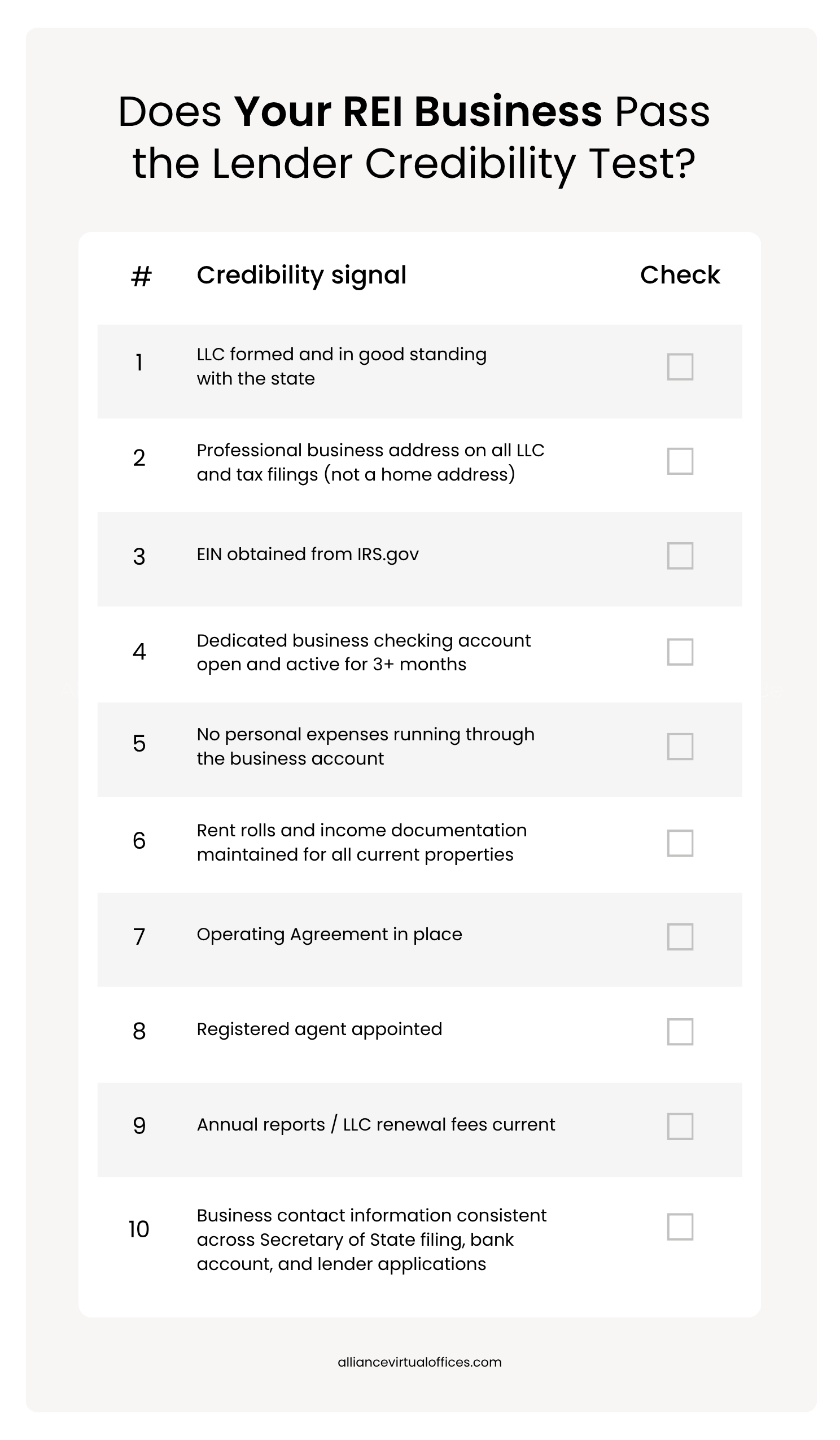
Treat this as a periodic audit, not a one-time setup. Review this list every six months and before any new loan application.
Build the REI Business Structure That Lenders Respect
Your credit score alone doesn’t build lender credibility; it’s the infrastructure surrounding your real estate investment LLC. The investors who move through underwriting fastest aren’t necessarily the ones with the best deals, but the ones who show up with a clean file: a formal LLC for real estate, a professional business address, a dedicated business account, an EIN, and documented cash flow.
That combination tells a lender everything they need to know before they look at the property.
LLCs that fall out of good standing, bank accounts that go dormant, and addresses that change without updating state filings are the cracks that show up during underwriting at the worst possible moment. Keep your filings and banking current, and review the checklist before each new deal.
Set up your real estate LLC with the same discipline you apply to evaluating properties. The business structure you build now is the infrastructure every future loan depends on, and the signal every lender reads before they say yes.
Alliance Virtual Offices provides professional business addresses at 500+ locations across the United States, meeting state filing requirements and accepted by lenders and financial institutions. Mail handling and forwarding are included, so your real-world mail management is covered alongside the address.
Browse Alliance Virtual Office Locations to find a professional business address for your real estate LLC at 1,400+ locations.
Frequently Asked Questions
Should I start an LLC for real estate investing?
Do I need a business address for my real estate LLC?
How do hard money lenders evaluate real estate LLCs?
What is the LLC loophole in real estate?
When is the right time to create an LLC for real estate?
Further Reading