- Is a Landscaping Business Profitable?
- Set Up Your Landscaping Business the Right Way
- Equipment and Startup Supplies
Q: How do you start a landscaping business?
A: Choose a business structure (LLC or sole proprietorship), get an EIN, secure a business address and license, add liability insurance, buy core equipment, and win first clients through local marketing.
Starting a landscaping business is an approachable self-employment option, due to the hands-on skills, steady demand, and the ability to begin lean.
According to the National Association of Landscape Professionals (NALP) per IBIS industry data, the U.S. landscape service industry reached $188.8 billion in 2025, growing at roughly a 6.5% annual rate since 2020. That’s a large, growing market with a relatively low barrier to entry.
The catch is that skill with a mower isn’t the same as running a business. Nearly half of small businesses close within five years, usually because of factors such as structure, pricing, and steady client flow rather than the quality of the work itself.
The good news is that every one of those factors is something you can plan for before you take your first job. This guide covers the full picture of how to start a landscaping business: what it costs, the equipment you need, and business requirements, such as having a professional business address from Alliance Virtual Offices.
Is a Landscaping Business Profitable? Costs, Earnings, and Market
Running a landscaping business can be profitable, but this depends on your costs, service mix, and how well you manage seasonal cash flow. Start with the numbers so you can judge the opportunity clearly.
How much it costs to start
Startup costs varies with how much equipment you buy up front. Forbes reports that starting a landscaping business can cost as little as $5,000 but be as high as $50,000 or more, mostly covering equipment costs, such as a truck and trailer, and whether you buy new or used.
Most landscaping business owners starting out don’t need the full-service figure. You can begin by purchasing the core gear, take on maintenance accounts, borrow tools, and reinvest into bigger equipment as revenue comes in.
Market size and demand
Demand isn’t the problem in this trade. The industry employs more than 1.4 million people across roughly 692,777 businesses nationwide, per NALP and IBISWorld industry data. A large market spread across residential and commercial work leaves room for new operators who show up reliably and communicate well.
Labor math and the survival reality
Wages tell you what your labor is worth as you hire. In 2024, the U.S. Bureau of Labor Statistics reported that median hourly pay for ground maintenance work was $18.50. Knowing that number helps you price jobs to cover your crew time; just make sure you have margin left over.
Although many small businesses close within their first five years, landscaping isn’t uniquely risky. The businesses that last are the ones that treat pricing, cash flow, and client retention as seriously as the work in the field.
What you can realistically earn
Earnings scale with your service mix and how many accounts you can serve. A solo operator running maintenance routes generally earns less per hour than one selling design and installation projects, because installation work carries higher margins and larger ticket sizes.
The practical path for most new owners is to build a base of recurring maintenance accounts for steady income, then add higher-margin project work as your reputation and capacity grow.
Margins improve in line with your efficiency. Tightening your routes so crews spend less time driving between jobs, pricing to cover labor and equipment with margin left over, and retaining clients season after season all matter more to profitability than the raw number of jobs you take. Growth for its own sake, without pricing discipline, is one of the fastest ways to end up busy and unprofitable.
Read More: The Ultimate Small Business Startup Checklist
Set Up Your Landscaping Business the Right Way
This is the step most new landscapers rush, and it’s the one that protects everything else. Getting your structure, address, and licensing right early keeps your personal assets separate and makes your business look established from day one.
Choose a structure: sole proprietorship vs. LLC
You have two common options when starting a landscaping business. Establishing a sole proprietorship is the default as it doesn’t require setup, but it means there’s no separation between you and the business, which could lead to your personal assets being exposed if something goes wrong on a job.
A Limited Liability Company (LLC), on the other hand, separates your personal and business assets, which matters in a trade with equipment, employees, and where property damage could occur. For a seasonal, equipment-heavy business, most owners form an LLC before taking on real client work, as it’s simple to set up and gives you room to grow.
Start by registering your business in the state where you operate. For a local landscaping business, your home state is almost always the right choice, since your clients and job sites are there and registering elsewhere just adds paperwork and cost.
As revenue grows, some owners ask their Certified Public Accountant (CPA) about electing S-corporation tax treatment for their LLC to reduce self-employment tax, but that’s an optimization later down the line, not a first-year concern.
Get an EIN and register the business
Once you choose a structure, get an Employment Identification Number (EIN) from the IRS. It’s free, takes minutes online, and you’ll need it to open a business bank account, hire, and file taxes.
Register your business name with your state, and if you plan to operate under a name different from your legal one, file a DBA, otherwise known as ‘Doing Business As’ (a registered trade or fictitious name to operate your business under) so your marketing name is on record.
Open a business checking account as soon as your paperwork is in order and route every dollar of income and expense through it. Mixing personal and business money is a common early mistake that muddies your bookkeeping, weakens your liability protection, and makes tax season far harder than it needs to be.
A clean set of business accounts from day one also gives you the paper trail lenders and vendors want to see later.
Use a professional business address, not your home address
You’ll need a business address to register your business, as a home address puts it on public records and on every estimate and invoice a residential client sees, causing a privacy and credibility concern. A professional business address from Alliance Virtual Offices gives you a real commercial street address for filings and marketing while keeping your home off the record.
Licenses, permits, and contractor requirements
Licensing is the part of setup that gets local, so don’t skip it. Most areas require a general business license, but some services need more. Pesticide and herbicide application, tree work, and larger installation jobs often require state or contractor licensing, as applying chemicals without the proper certification can bring fines that dwarf the cost of getting licensed.
Check your city and state requirements before you advertise those services and confirm whether your county requires any additional permits.
Insurance for Your Landscaping Business
Insurance isn’t optional in a trade where you operate heavy equipment on other people’s property. It’s also often required before a commercial client or property manager will hire you.
Start with general liability coverage. It protects you if you damage a client’s property or someone gets injured because of your work, which is a real risk with mowers, blowers, and chemicals in the mix. Residential clients generally won’t ask for proof, but commercial accounts almost always will.
As you add equipment and people, layer in more coverage. Here’s how the common policies map to a growing landscaping business:
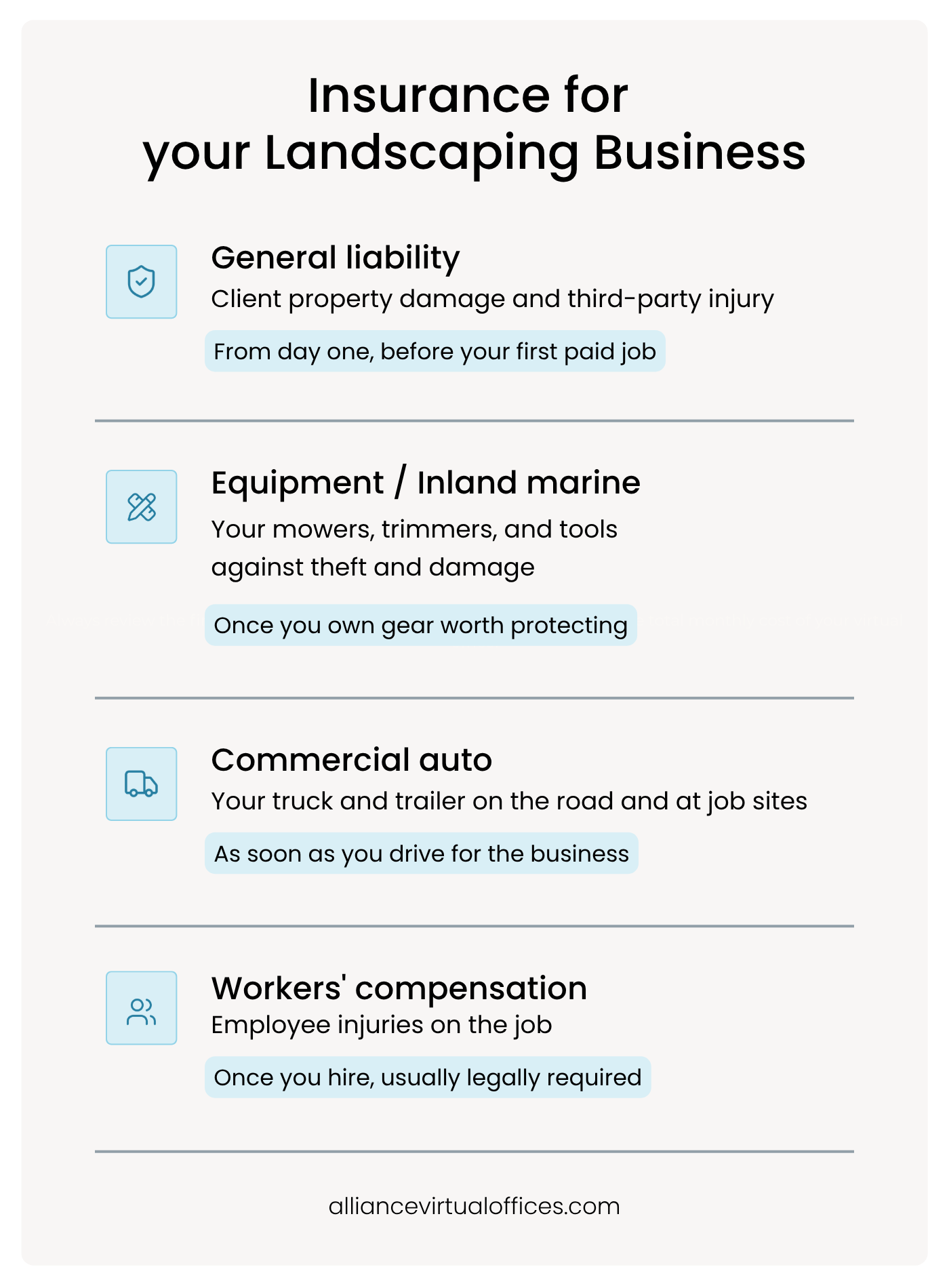
Build the coverage up as the business grows rather than buying everything at once. Talk to an agent who works with contractors and trades, since they’ll know the local requirements and can bundle policies as you scale. Keeping proof of insurance handy also speeds up winning commercial accounts, as many commercial clients won’t sign on a contractor who can’t show current coverage.
Equipment and Startup Supplies
Your equipment list is where a large share of your startup budget goes, so buy deliberately. You don’t need everything at once, and buying more than you can keep busy is a common early mistake.
Core gear
Start with the equipment that pays for itself on maintenance routes, such as a reliable commercial mower, a string trimmer, a leaf blower, and a set of quality hand tools. Commercial-grade gear costs more up front but survives daily use in a way consumer models don’t, and downtime from a failed consumer mower costs you far more than the price difference.
A realistic starter kit for a solo maintenance operation looks like this:
- A commercial walk-behind or stand-on mower.
- A string trimmer.
- A backpack blower.
- An edger.
- A set of hand tools (rakes, pruners, shovels).
- Safety gear.
- Fuel containers.
Add a hedge trimmer and a spreader once you take on fuller-service accounts. You can expand from there as the work demands it, but having this core kit is enough to service most residential maintenance routes profitably.
Truck and trailer
You need a way to move equipment between jobs. A used pickup and an enclosed or open trailer are standard, and the enclosed option doubles as secure storage and mobile advertising when you add your business name.
Buy, rent, or finance when starting lean
You don’t have to own all this equipment immediately, but here’s a simple way to decide:
Starting lean and reinvesting keeps you out of debt while you prove demand in your business and build it up. Once your work becomes predictable, financing a larger mower or a second crew’s gear becomes a reasonable growth move.
Write a Simple Landscaping Business Plan
A landscaping business plan doesn’t need to be a formal document for a bank. But it does need to answer how you make money, what you charge, and how you get through the slow months.
Pricing and service packages
Decide which services you offer and price them for profit, not just to win the job. Most landscapers build three services, including:
- Recurring maintenance (mowing, cleanup, seasonal care).
- Design and installation (higher-margin project work).
- Seasonal services (leaf removal, snow in some regions).
Recurring maintenance creates the predictable base; project work drives the bigger paydays.
Price every job to cover your labor (at an hourly rate), equipment and fuel costs, and a margin on top. New owners often price low to win work and end up busy but broke, because they didn’t account for equipment wear, drive time, or their own time. Selling maintenance as a monthly or seasonal package rather than one-off visits also locks in recurring revenue and makes your income easier to forecast.
Managing seasonal cash flow
Seasonal cash flow is the reality that catches new owners off guard. Revenue spikes in spring and summer and can fall sharply in winter, so plan for it.
Set aside a portion of peak-season income to cover the slow months, offer prepaid annual maintenance contracts to smooth revenue, and consider adding an off-season service where the climate allows. Treating cash flow as a plan rather than a surprise is often what separates the businesses that last from the ones that don’t.
Get Your FREE Guide Today!
How to Start a Business in a Recession
Land Your First Landscaping Clients
Client acquisition is the last piece of how to start a landscaping business. For a new landscaper, this comes down to being visible and easy to reach in your local market.
Local marketing that works
Start where your customers already look. Set up a Google Business Profile so you appear in local map results, ask every satisfied customer for a review and a referral, and use targeted door hangers or yard signs in neighborhoods where you already have a client. In a trade built on trust and proximity, local reputation compounds faster than paid ads.
A few tactics tend to produce the best early results. Route density is your friend, as winning several residential clients who live on the same street cuts drive time and raises your effective hourly rate, so market hardest where you already work.
Branded truck and trailer lettering turns every job into a rolling advertisement. And a simple referral incentive, such as a discount for a client who refers a neighbor, quietly grows your route without ad spend. Consistency matters more than any single channel, so pick two or three tactics and work them every week.
Capture seasonal lead spikes: answer every call
Springtime is when demand for landscaping comes in highest, but it’s often the time when you’re on a mower and can’t pick up the phone. A missed call is frequently a lost job, because a homeowner who can’t reach you simply calls the next landscaper on their list.
However, having a Live Receptionist service or a dedicated virtual phone number overcomes this problem, answering your calls professionally even when you’re in a field, turning seasonal demand into booked work instead of voicemails.
NEXT STEPS: Explore Virtual Office Plans
Starting Your Landscaping Business the Right Way
Knowing how to start a landscaping business comes down to sequencing a handful of decisions well. Judge the opportunity with real numbers, choose a structure that protects you, set up a professional address and the right licenses, buy equipment deliberately, price for profit, plan for the seasons, and make yourself easy to hire.
Do those things and you give yourself a real shot at making it past year five in your business. You already do the landscaping work well; the setup around it is what turns that skill into an established business that’s ready to answer when peak season demand comes calling.
When you’re ready to build a professional foundation under your new landscaping business, a business address and call answering service from Alliance Virtual Offices are two of the fastest ways to look established from day one.
To get started, establish a professional business address from Alliance, starting at only $49 per month.
Frequently Asked Questions
How much does it cost to start a landscaping business?
Do you need a license to start a landscaping business?
Is a landscaping business profitable?
What equipment do I need to start a landscaping business?
Do I need insurance for a landscaping business?
Further Reading