
- How Home Office Deductions Actually Work
- What a Virtual Office Actually Costs
- When a Virtual Office Is the Smarter Move
Q: Can a virtual office subscription be tax-deductible?
A: Yes. A virtual office subscription qualifies as a legitimate business expense and is fully deductible in most cases. Unlike a home office deduction, it does not require calculating exclusive-use square footage or meeting IRS eligibility criteria.
Tax season has a way of making every business decision feel more consequential than it actually is. The question of whether to claim a home office deduction or pay for a virtual office subscription is one of the most common ones, and the answer depends less on which option looks cheaper on paper and more on how your business actually operates.
This post breaks down both options: what qualifies, what it costs, and when the math favors one over the other.
Note: This post is for informational purposes only. Consult a qualified tax professional before making decisions about deductions or business expenses.
How Home Office Deductions Actually Work
The IRS allows self-employed individuals and business owners to deduct a portion of home expenses if they use part of their home regularly and exclusively for business.
The key word is exclusively: a guest room that doubles as your office does not qualify, and neither does a kitchen table where you also eat meals.
Two Methods for Calculating the Deduction
Simplified method: $5 per square foot of dedicated workspace, up to 300 square feet. Maximum deduction: $1,500 per year. Easy to calculate but limited in value.
Actual expense method: Deduct a percentage of your actual home expenses (rent or mortgage interest, utilities, insurance, repairs) based on the proportion of your home used for business. More complex, but potentially higher deductions for larger or more expensive home offices.
The Catch
Claiming the home office deduction correctly is not inherently risky. But correctly means strict documentation, genuine exclusive-use compliance, and a workspace that holds up to questions. A dedicated room with a door you close at the end of the workday is far easier to defend than a corner of a shared space.
“The home office deduction is legitimate and often underused. But it only delivers real value if your workspace genuinely qualifies and your records are clean.”
Everything You Need to Grow Your Business

That’s what you get with a custom
Virtual Office Plan from Alliance
Select:
- Virtual Office
- Live Receptionist
- Virtual Phone
- Meeting Rooms
- Coworking
- Full Time Office
What a Virtual Office Actually Costs (and What You Can Deduct)
A virtual office subscription is a business expense, which means it is fully deductible in most cases. No square footage calculations, no exclusive-use requirements, no gray areas.
Typical virtual office costs:
- Business address only: From $48 per month ($576 per year)
- Address with mail handling: $48 to $100 per month
- Full package (address, phone, live receptionist): $125 to $300+ per month
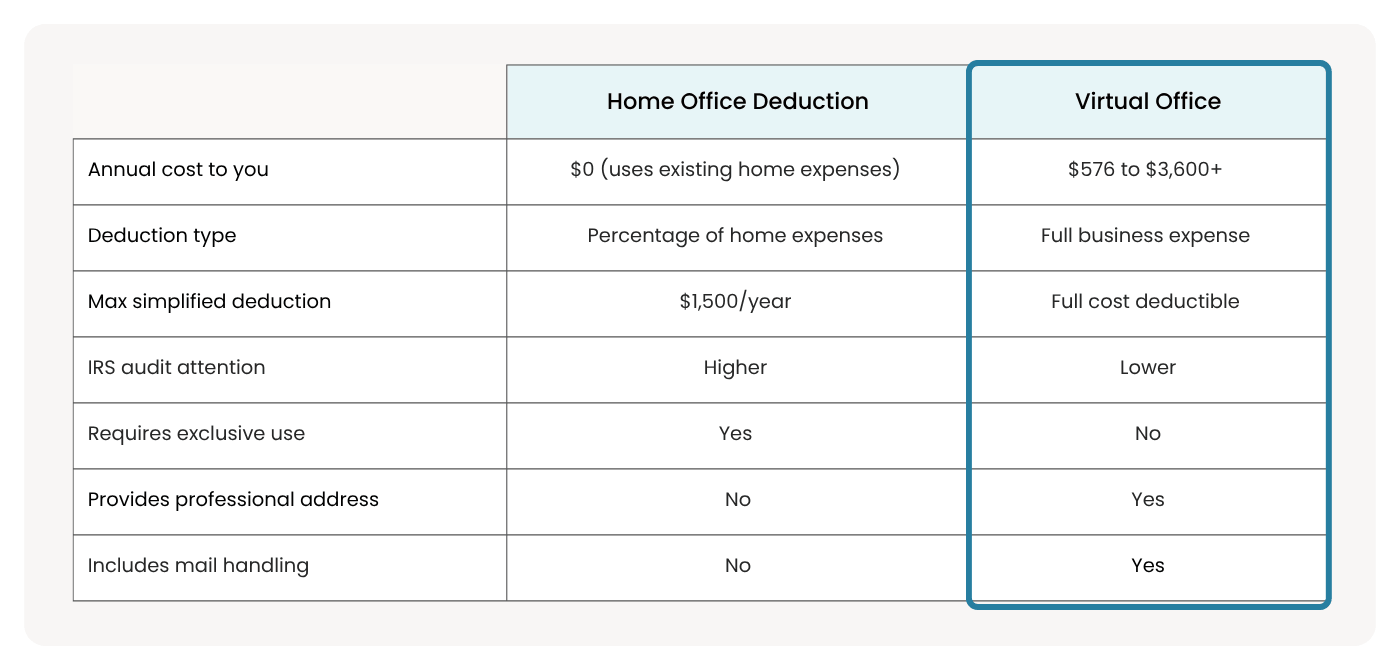
Every dollar spent on a virtual office subscription generally reduces your taxable business income dollar-for-dollar. The deduction is clean because the expense is entirely and clearly business-related.
NEXT STEPS: Explore options by location and service level.
When a Virtual Office Is the Smarter Move
The home office deduction puts money back in your pocket at tax time. A virtual office costs money year-round but delivers operational value that a deduction cannot.
Freelancer with minimal client interaction: The simplified home office deduction ($1,500 max) may cover most of the tax benefit. A basic virtual address at $48 per month adds professional credibility and a fully deductible expense, and the net cost after deduction is modest.
Consultant or service business pitching higher-value clients: A residential address on proposals creates credibility friction before a single conversation happens. A virtual address in a recognized business district removes it. Why your home address hurts covers the full picture of what’s at stake when personal and business addresses overlap.
Growing business that needs clear separation: Once your business address is tied to your home, updating registrations, filings, bank accounts, and marketing materials is time-consuming. Starting with a virtual address avoids that problem entirely.
The Hybrid Approach
You do not have to choose one or the other. If part of your home genuinely qualifies as exclusive-use workspace, that deduction still applies. A virtual office subscription is a separate, fully deductible business expense on top of it. Many business owners use both: the home office deduction for their actual working space and a virtual address for their public-facing business presence.
NEXT STEPS: Should You Use Your Home Address for Your Business?
The Bottom Line
The home office deduction is a useful tool when your workspace genuinely qualifies and your documentation is solid. It is not a substitute for a professional business presence.
A virtual office does more than reduce your tax bill. It gives your business a credible address, handles your mail, and separates your personal privacy from your public business record. Those advantages show up every day, not just in April.
For most small businesses and solopreneurs, the question is not which option to choose. It is whether the operational value of a professional business presence justifies a modest monthly expense. For most, it does.
Compare virtual office providers to evaluate your options.
Further Reading