
- What Is a Virtual Phone Number and How Does It Work
- Setting Up Your Virtual Phone Number: Step by Step
- Why Alliance Virtual Offices for Your Virtual Phone Number
Q: What is a virtual phone number?
A: A virtual phone number is a business phone line not tied to a physical location or device. Calls route to whatever number or device you designate, giving you consistent, professional coverage whether you’re working from an office, a home setup, or multiple locations at once.
Running a business without a dedicated phone number costs more than most owners realize. Missed calls, personal numbers on marketing materials, and unanswered inquiries during off-hours all chip away at the professional image your business works to build. A virtual phone number solves these problems without requiring a landline, a dedicated device, or a physical office.
This guide covers everything you need to know: how virtual phone numbers work, what they cost compared to traditional lines, how to get one running in under an hour, and which advanced features are worth paying for.
What Is a Virtual Phone Number and How Does It Work
Virtual phone numbers are one of those tools that sound more technical than they are. Understanding the basics makes it much easier to evaluate your options and set up the right system for your business.
Virtual phone numbers operate over the internet rather than through a traditional copper-wire phone network. When someone dials your virtual number, the call routes through a VoIP (Voice over Internet Protocol) system to whatever device or number you’ve designated: your cell phone, a desk phone, a team member’s line, or a combination of all three.
How the Routing Works
Your virtual number acts as the front end for your actual devices. You choose which phones ring when the number is called, in what order, and for how long before the call rolls to voicemail or another team member. That routing logic is configurable, adjustable in real time, and requires no hardware changes to update.
Types of Virtual Phone Numbers
Not all virtual numbers serve the same purpose. The right type depends on where your clients are and how you want to position your business.
Local numbers carry a specific area code, signaling a local presence to callers. For service businesses tied to a geographic market, a local number builds familiarity and trust with the community before the conversation even starts.
Toll-free numbers (800, 888, 877, etc.) signal a national or enterprise-level presence. Callers pay nothing to reach you, which removes friction for clients who might hesitate before dialing a long-distance number.
International numbers give businesses a local-looking number in a country where they operate or have clients, even if the business is physically located elsewhere. For U.S. businesses serving international markets, or international founders building a U.S. presence, this is the practical solution.
The connection between your phone number and your professional credibility runs deeper than most owners expect.
Key Benefits of a Virtual Phone Number for Your Business
The most immediate benefit of a virtual phone number is separation: your personal cell stays private, your business line stays professional. But the advantages extend well beyond keeping numbers distinct.
Professional Image That Holds Up at Every Stage
A dedicated business phone number signals legitimacy to clients, vendors, and partners before the call even connects. It is one of the baseline credibility markers that prospective clients check before deciding whether to trust a business. A personal cell number on your website creates doubt. A local or toll-free number removes it.
This matters at every stage of business growth. Startups need it to compete with established players. Established businesses need it to maintain a consistent brand across every touchpoint. Solo operators need it to protect their personal privacy while staying reachable.
The same logic applies to your business address. Why your home address hurts explains why both your number and your address shape first impressions before a single conversation happens.
Accessibility Without Being Tethered to a Desk
Virtual numbers route to wherever you are. Whether you are traveling, working from home, or splitting time between multiple locations, your business number reaches you consistently. Callers experience the same professional front end regardless of where you actually are when the call comes in.
For remote teams, this is especially valuable. A single business number can ring across an entire distributed team in a defined sequence, ensuring that no call goes unanswered even when one team member is unavailable.
The best thing about a virtual business number isn’t what it does for your calls. It’s what it does for your credibility before the call ever happens.
Call Management That Keeps You in Control
Most virtual phone systems include call forwarding, call screening, voicemail-to-email transcription, hold music, and custom greetings as standard features. These tools let you manage how callers experience your business without requiring a receptionist or an IT department.
Robocall screening and spam filtering are also standard on most plans, which reclaims significant time for businesses that currently field a high volume of unwanted calls. For context, U.S. businesses received an estimated 50 billion robocalls in 2023 alone. Having a buffer between your real line and that noise is not optional anymore.
Cost Savings Compared to Traditional PBX Systems
A traditional PBX phone system requires hardware, installation, ongoing maintenance, and dedicated lines for each user. Monthly costs for a multi-user PBX system typically run into hundreds of dollars before maintenance and hardware replacement are factored in. Virtual phone systems on VoIP infrastructure typically run $20 to $50 per user per month with no hardware required.
For small businesses and solopreneurs, the math is even more straightforward: a virtual number starts at a fraction of the cost of any traditional business line, with no installation fee and no long-term contract.
The case for your own number breaks down exactly what is at stake when businesses rely on personal numbers for professional communication.
Unlock Our Current Virtual Office Offers
Enter your email below and we’ll send you the latest available promotions and monthly specials for Virtual Offices, Meeting Rooms, and Live Receptionists.
How Virtual Phone Numbers Compare to Traditional Phone Lines
Traditional phone systems served businesses well for decades, but they were built for a world where everyone worked in the same building, answered calls at a fixed desk, and paid a telecom provider for each physical line installed. That model does not map to how most businesses operate today.
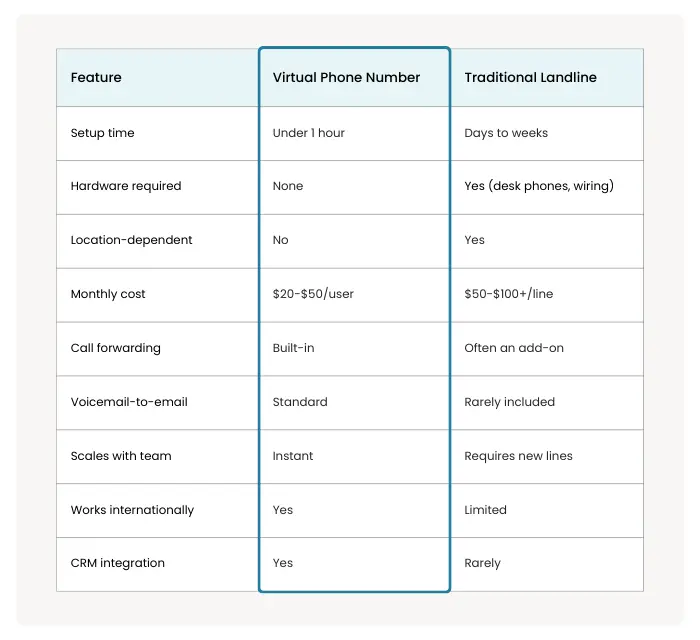
The cost and flexibility gap is significant, but the bigger issue is the operational gap. A traditional line is anchored to a location. If your team works remotely, travels frequently, or operates across multiple offices, a fixed line creates coverage blind spots that a virtual number eliminates by design.
Where Traditional Lines Still Have a Role
A landline is not always the wrong answer. High-volume call centers with fixed locations and dedicated hardware infrastructure may still operate efficiently on traditional systems. Emergency service providers often require landline redundancy for reliability reasons. For most small businesses and distributed teams, those exceptions do not apply.
The VoIP Advantage
VoIP (Voice over Internet Protocol) is the technology underlying most virtual phone numbers. It converts voice audio into digital data packets and transmits them over your internet connection. Call quality on modern VoIP systems is indistinguishable from traditional lines for the vast majority of users, and the infrastructure cost is dramatically lower.
VoIP adoption among small businesses has grown steadily as broadband internet became universal. The question is no longer whether VoIP quality is good enough. It’s whether a traditional line offers anything VoIP doesn’t.
For small businesses evaluating the switch, the practical answer is almost always no. VoIP covers the use case and costs a fraction of the alternative.
Setting Up Your Virtual Phone Number: Step by Step
Setup for a virtual phone number is faster than most business owners expect. Most providers have you from signup to live calls in under an hour.
Step 1: Choose your number type. Decide between local, toll-free, or international based on your market positioning. Local numbers work best for geographically focused service businesses. Toll-free numbers signal scale and national reach. International numbers solve the cross-border presence problem for businesses building a U.S. presence from abroad.
Step 2: Select your plan. Most virtual phone providers offer tiered plans based on the number of users, call minutes, and features included. Start with the tier that fits your current volume. Upgrading is typically instant and does not require a new contract.
Step 3: Configure call forwarding. Designate which device or number receives your calls. Set the ring order if you want calls to try multiple numbers before rolling to voicemail. Configure simultaneous ring if you prefer all devices to ring at once.
Step 4: Set up your voicemail and custom greeting. Record a professional greeting that includes your business name and sets caller expectations clearly. Configure voicemail-to-email transcription so missed calls land in your inbox as readable text rather than requiring you to listen through a voicemail queue before responding.
Step 5: Add a live receptionist (optional but high impact). For businesses that want human coverage on every call, pairing your virtual number with a live receptionist means callers never reach voicemail during business hours. The live receptionist complete guide covers how the setup works, what it costs, and which businesses benefit most.
Step 6: Test before going live. Call your own number from an outside line before announcing it to clients. Verify the greeting, the routing, and the voicemail behavior. Update your website, email signature, and any marketing materials with the new number before making the switch official.
Get a professional U.S. number walks through the full process, including international setup for businesses building a U.S. presence from abroad.
Advanced Features Worth Knowing About
The basics cover most business needs. But several advanced features are worth understanding, especially for businesses with growing teams or more complex call workflows.
Auto-Attendant and IVR Systems
An auto-attendant greets callers and routes them based on keypad input: press 1 for sales, press 2 for support. For businesses with multiple departments or team members, this removes the need for a human to route every call manually. More sophisticated IVR (Interactive Voice Response) systems can handle FAQs, account lookups, and basic transactions without any live agent involvement.
The practical benefit for small businesses is scale. An auto-attendant makes a two-person operation sound like a ten-person team to callers, which matters when you are competing for clients who associate staff size with reliability.
Call Analytics and Reporting
Most virtual phone platforms track call volume, duration, missed call rates, and peak call times. For businesses running marketing campaigns with tracked phone numbers, call analytics reveal which channels are driving calls and which are underperforming. This data is useful for staffing decisions, script optimization, and overall workflow planning.
For businesses that advertise across multiple channels, separate tracked numbers for each campaign turn your phone system into a performance measurement tool.
CRM Integration and Call Tagging
Many virtual phone systems integrate directly with CRM platforms like HubSpot, Salesforce, and Zoho. Incoming calls automatically log against a contact record, and call recordings attach to the timeline. Call tagging lets you categorize calls by type (lead, support, billing) for later analysis and follow-up.
For sales-driven businesses, this integration closes the gap between marketing data and sales execution. Every call becomes a logged data point that feeds into pipeline reporting.
International Expansion Support
Virtual numbers make international operations manageable for businesses without local offices in every market. A U.S.-based business with clients in the UK can maintain a local UK number that routes to the same team handling domestic calls. The caller experience is local; the operation is centralized.
Unlock Our Current Virtual Office Offers
Enter your email below and we’ll send you the latest available promotions and monthly specials for Virtual Offices, Meeting Rooms, and Live Receptionists.
Why Alliance Virtual Offices for Your Virtual Phone Number
Alliance Virtual Offices offers virtual phone numbers as part of a broader business infrastructure platform that includes professional addresses, mail handling, and live receptionist service. For businesses that want a single provider for their entire professional front end, that integration is a meaningful operational advantage.
Virtual phone numbers through Alliance work as a standalone product or as part of a package with a virtual office address. For businesses building a credible professional presence from scratch, combining a business address, a dedicated phone number, and live receptionist coverage under one account removes the friction of managing multiple vendors and billing relationships. If you’re new to the model, what a virtual office includes breaks down the full service before you decide.
Alliance serves small businesses, solopreneurs, remote teams, and international entrepreneurs who need a U.S. presence without a U.S. office. With access to more than 4,000 locations and plans that scale as your business grows, the setup expands when you need it to without requiring a new contract or a call to IT.
Alliance virtual phone number plans cover local and toll-free options with transparent pricing and no long-term commitments.
Getting Started: What to Do This Week
A virtual phone number is one of the fastest wins available to a small business or remote team. Setup takes less than an hour, the cost is low relative to the credibility return, and the professional impact is immediate.
If you are currently using a personal cell number for business calls, the case for switching is clear: you gain a professional front end, call management tools, and the ability to separate work from personal life without missing a single business call.
If you already have a business number tied to a physical line, a virtual number gives you the flexibility to work from anywhere, add team members without hardware, and integrate modern call management features that traditional systems do not offer.
The first step is choosing the right number type for your market. Everything else follows from there. If you’re still weighing providers, comparing virtual office providers gives you a framework for evaluating what actually matters before you commit.
Frequently Asked Questions
Q: What is a virtual phone number?
A: A virtual phone number is a business phone line not tied to a physical location or device. Calls route to whatever number or device you designate, giving you professional, consistent coverage wherever you are working.
Q: How can a virtual phone number benefit my business?
A: It provides a professional image, keeps your personal number private, allows remote access from any device, and includes call management tools like forwarding, screening, and voicemail transcription. It also costs significantly less than a traditional business line with far more flexibility.
Q: Can I get a virtual phone number if I don’t live in the U.S.?
A: Yes. Alliance Virtual Offices offers virtual U.S. phone numbers for international businesses, enabling a local presence and professional credibility in the U.S. market without requiring a physical office.
Q: How do I set up a virtual phone number?
A: Select your number type (local or toll-free), configure forwarding and voicemail, optionally pair it with live receptionist service, and you’re live. Most businesses complete the setup in under an hour.
Q: Can a virtual phone number replace my traditional business line?
A: For most small businesses and remote teams, yes. Virtual numbers offer the same call quality with greater flexibility, lower cost, and features that traditional lines do not include by default.
Q: How does a virtual phone number work with live receptionist service?
A: Your virtual number forwards incoming calls to your live receptionist team. They answer in your business name, screen and route calls, and deliver messages in real time. The caller experience is seamless, and you receive messages without interrupting your workflow.
Q: Why choose Alliance Virtual Offices for a virtual phone number?
A: Alliance combines virtual phone service with professional business addresses and live receptionist coverage under one platform, making it a strong fit for businesses that want a complete professional presence without managing multiple vendors.
Recommended Reading:
- 10 Reasons Not to Use Your Personal Phone for Business
- Business Virtual Phone Number: The Benefits and How to Get One
- Get a professional U.S. number
- What is a live receptionist?
Ready to Set Up Your Business Phone Number?
Alliance can have your virtual phone number live in under an hour.
Call us: 1-800-338-3995
Chat with us: alliancevirtualoffices.com
Explore plans: Virtual phone number options