


- What Are Law Firm Business Address Requirements?
- Legal & Ethical Implications of Your Office Address
- State Bar Rules: What Lawyers Need to Know
- Practical Options for Modern Law Firms
Q: What kind of business address does a law firm need to stay compliant and professional?
A: Law firms must maintain a physical, staffed business address where clients, regulators, and courts can reach them. This address must allow for secure mail handling, protect client confidentiality, and meet state bar rules for accessibility and transparency. A virtual office that provides a real, staffed commercial location fulfills these requirements, offering compliance, privacy, and professionalism without the cost of a traditional lease.
“Over 60% of solo attorneys now operate remotel-but every one of them must maintain a compliant business address for bar registration and client trust.”
– ABA 2024 Remote Practice Report
As an attorney running your own practice, the question isn’t if you need a business address, it’s what kind of address meets your professional and ethical requirements.
A compliant business address is more than a formality. It’s a foundation of trust, transparency, and accessibility that supports every aspect of your law practice from bar registration and advertising to client communication and document security.
In this guide, we’ll explore the legal, ethical, and practical considerations behind law firm address requirements, and how virtual office solutions can help you meet them while protecting your privacy and reputation.
👉 Learn how to protect your firm’s reputation and compliance with the right address solution.
P.S. – If you’re setting up a new practice, see our guide on how to start a virtual law firm.
What Are Law Firm Business Address Requirements?
A business address is the official, publicly listed location where your law firm operates, receives mail, and can be contacted by clients, courts, and regulatory authorities.
In legal practice, this address plays a critical role in verifying your firm’s legitimacy and ensuring compliance with bar association and governmental requirements. It’s not simply where your mail is sent. It’s also part of your professional identity.
Why Your Business Address Matters
Law firms must maintain a verifiable address for several core reasons:
- State Bar Registration: Every attorney must list a physical business address during bar registration and renewal.
- Client Correspondence: Clients expect a professional, reachable address for trust and communication.
- Court Filings and Public Listings: Most jurisdictions require an official business address on pleadings, contracts, and public directories.
- Advertising & Ethics Compliance: Under ABA Model Rules 7.1 and 7.2, lawyers must include a physical office address on websites, ads, and marketing materials.
- Service of Process: Your firm must have a valid, physical address where legal documents can be formally delivered.
Without a compliant business address, your firm risks disciplinary inquiries, lost mail, and a dubious professional image.
Key distinctions:
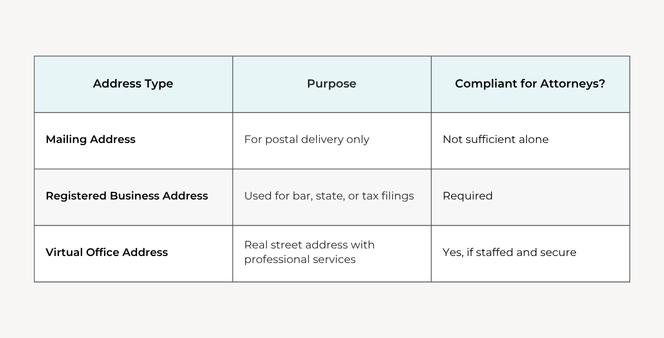
A compliant address ensures clients, regulators, and courts can reliably reach your firm and that you meet every legal and ethical obligation tied to professional conduct.
The Professional and Ethical Significance
In law, your business address communicates legitimacy, stability, and accountability.
When a client, opposing counsel, or regulator sees your firm listed at a real business address, it conveys that you operate within professional standards and are available for contact or service.
By contrast, listing a home address or a mailbox service can:
- Undermine client confidence.
- Expose private residences to public records.
- Violate bar rules on accessibility and advertising accuracy.
A compliant address ensures that:
- Your firm is reachable by clients and courts.
- You meet ethical standards for transparency and accessibility.
- Your operations align with confidentiality and professional conduct obligations.
In short, a compliant business address is both a regulatory requirement and a symbol of professional credibility; the first sign to the world that your firm operates with integrity and accountability.
Legal & Ethical Implications of Your Office Address
Logistics are great when it comes to your law address, but it’s also tied directly to your ethical duties under the ABA Model Rules of Professional Conduct.
Key Rules to Know
- Rule 7.1: Prohibits misleading communications about your services, including false or vague office locations.
- Rule 7.2: Requires truthfulness in advertising and contact information.
- Rule 1.6: Protects client confidentiality, which can be compromised if personal addresses are exposed.
Privacy Risks of Home Addresses
The rise of remote and hybrid law practices has made home offices increasingly common; but using your home address as your firm’s official business location can create significant privacy, ethical, and safety concerns.
When your residential address appears on bar registration databases, websites, or court filings, it becomes part of the public record. Anyone-clients, opposing counsel, or members of the public-can access that information with a simple search.
That exposure can lead to:
- Personal safety risks for you and your family, especially in contentious practice areas like criminal defense, family law, or litigation.
- Unwanted client visits or correspondence at your private residence.
- Difficulty separating personal and professional boundaries, which can undermine client perceptions of professionalism.
- Confidentiality issues, since sensitive legal mail could be delivered to a non-secure location.
For these reasons, most compliance experts strongly advise attorneys to avoid using residential addresses for any professional registration, client communication, or public-facing materials.
PO Boxes and Shared Spaces
Some attorneys try to balance privacy with simplicity by using a P.O. Box or shared coworking space for mail collection. Unfortunately, most bar associations have made it clear that these options do not satisfy professional address requirements.
The reasoning is simple:
Bar associations require a physical, staffed address that reflects a lawyer’s ongoing presence and accountability to clients and the public.
A P.O. Box or unstaffed coworking desk fails to provide that.
For example:
- The Florida Bar mandates that every lawyer maintain a physical office location where they can be contacted and served with legal documents during regular business hours.
- The State Bar of California has similar rules, requiring attorneys to list an address that is open to the public and capable of receiving service of process.
- The ABA’s Formal Opinion 495 (2021) affirms that even fully remote attorneys must maintain a business address where clients and regulators can reliably reach them, regardless of where they physically work.
In practical terms, this means that your law firm’s business address must be accessible, secure, and professionally managed. It’s not just a forwarding address or mailbox number.
Consequences of Noncompliance
Failing to comply with these requirements can lead to more than just administrative inconvenience. Attorneys have faced:
- Delayed license renewals or disciplinary investigations due to incomplete or noncompliant address listings.
- Missed service of process or client correspondence, which can expose firms to malpractice risks.
- Damage to professional reputation, as clients may perceive a lack of legitimacy when a firm lists a residential or mailbox address.
To protect your privacy and maintain compliance, a virtual office address provides the ideal balance: it offers a staffed, physical business location that satisfies bar requirements while shielding your personal residence from public view.
State Bar Rules: What Lawyers Need to Know
While the ABA sets ethical guidelines, compliance ultimately depends on each state’s bar association.
Here’s a snapshot of 2025 requirements across major jurisdictions:
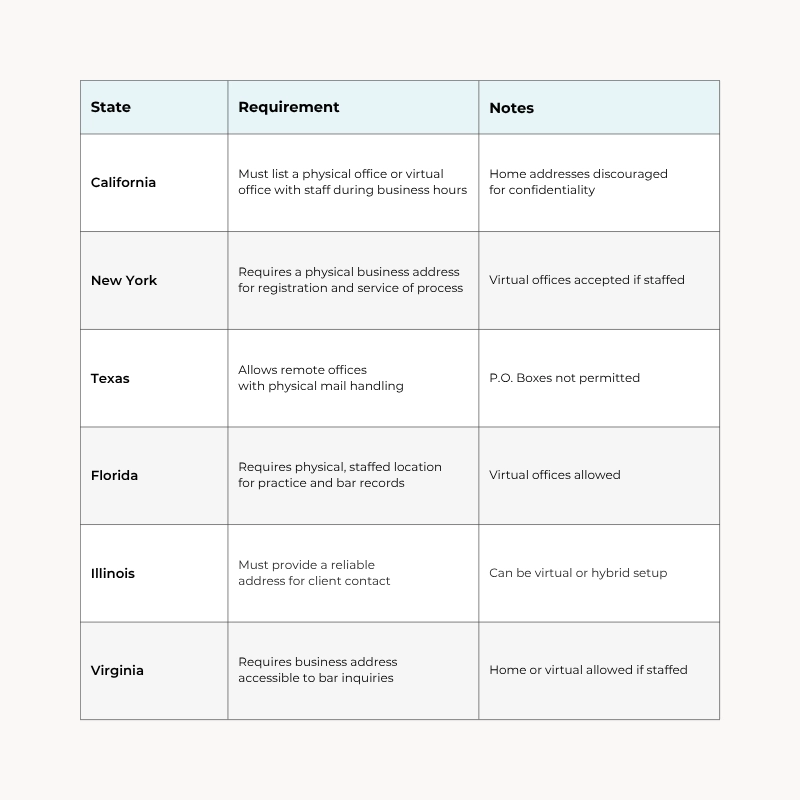
➡️ For more compliance guidance, read our business compliance tips.
Similar to CPA requirements, attorneys must maintain a staffed, compliant address. Learn more about virtual office compliance for CPAs.
Practical Options for Modern Law Firms
Today’s attorneys can choose from multiple workspace model-but not all meet compliance standards. Here’s how each option compares:
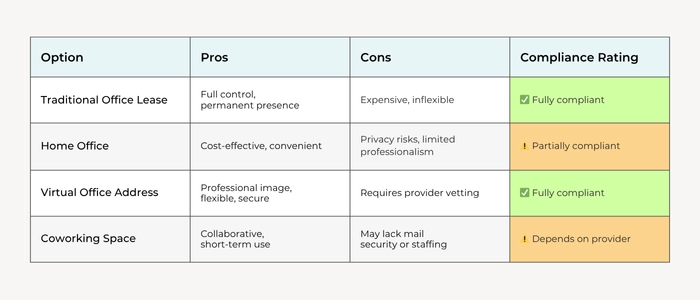
A professional mailing address ensures you maintain privacy and professionalism even without a permanent physical lease.
How Virtual Offices Support Legal Compliance
A lawyer virtual office is a modern, compliant solution designed for attorneys operating remotely or managing hybrid practices.
Unlike mail-only or unstaffed coworking setups, a virtual office provides the infrastructure and accountability that bar associations require – all without the overhead of a long-term lease.
Virtual offices bridge the gap between flexibility and compliance, allowing lawyers to meet ethical standards for accessibility, confidentiality, and professionalism while maintaining a scalable, cost-effective business presence.
Here’s How a Virtual Office Meets Legal Industry Standards
1. Physical, Staffed Address
Every Alliance Virtual Offices location offers a real, commercial street address staffed by onsite personnel during regular business hours.
This ensures your firm can receive service of process, client mail, and official communications in compliance with state bar rules.
Unlike P.O. Boxes or mailbox centers, virtual offices provide verifiable, legitimate business locations, satisfying the “physical presence” criteria in states like California, New York, and Florida.
2. Mail Handling & Forwarding
Lawyers are bound by Rule 1.6 of the ABA Model Rules to safeguard client confidentiality. Alliance’s secure mail-handling systems protect sensitive correspondence with locked storage, restricted staff access, and reliable forwarding options.
Mail can be automatically redirected to your home, scanned securely, or held for pickup, thereby ensuring client materials are handled with attorney-client privilege in mind.
3. Meeting Room & Day Office Access
Many bar associations still expect attorneys to have a private, professional space available for client consultations or regulatory inquiries.
Alliance Virtual offices provide on-demand access to conference rooms and private offices for depositions, client meetings, or interviews – helping you maintain professionalism and discretion even as a remote practitioner.
4. Multi-State Expansion
For multi-jurisdictional firms or attorneys admitted in multiple states, virtual offices make it easy to establish a compliant business address in each jurisdiction.
Rather than leasing multiple offices, you can open satellite locations virtually, each staffed, physical, and bar-compliant, enabling a scalable, nationwide presence.
5. Confidentiality & Security
Legal professionals handle some of the most sensitive data imaginable. Alliance’s centers use controlled access, secure mailrooms, and verified staff protocols to protect confidentiality at every step.
This not only aligns with ethical obligations but also reinforces client trust, showing your firm takes privacy and data protection seriously.
Real-World Example
Consider a solo attorney based in Austin, Texas, who wanted to expand their practice into Florida. Instead of leasing a costly second office, they used an Alliance Virtual Office in Miami as their satellite business address.
- The address met the Florida Bar’s physical presence rule,
- Mail and client documents were securely forwarded, and
- Alliance’s meeting room access allowed in-person consultations when visiting the city.
In just weeks, the attorney achieved multi-state compliance and gained new clients-without sacrificing privacy or taking on overhead.
For modern legal professionals, a virtual office isn’t just a convenience – it’s a compliance tool that satisfies bar requirements, protects client confidentiality, and projects professionalism across every jurisdiction where you’re admitted.
By combining staffed physical addresses, secure mail systems, and flexible workspace access, Alliance helps law firms stay ethical, compliant, and competitive in the era of remote practice.
Why Choose Alliance Virtual Offices for Law Firms
Thousands of attorneys trust Alliance Virtual Offices to support their professional presence and compliance.
Here’s why:
- 1,400+ global locations – Each staffed, secure, and compliant with bar standards.
- Flexible plans – Scale your address as your practice grows.
- Mail privacy & forwarding – Protect client data and personal privacy.
- On-demand meeting rooms – Book meeting rooms for client consultations anytime.
- Multi-jurisdiction support – Expand your footprint without new leases.
- Live receptionist services – Enhance professionalism with personalized client calls.
A virtual office with Alliance provides everything your law practice needs: compliance, credibility, and convenience.
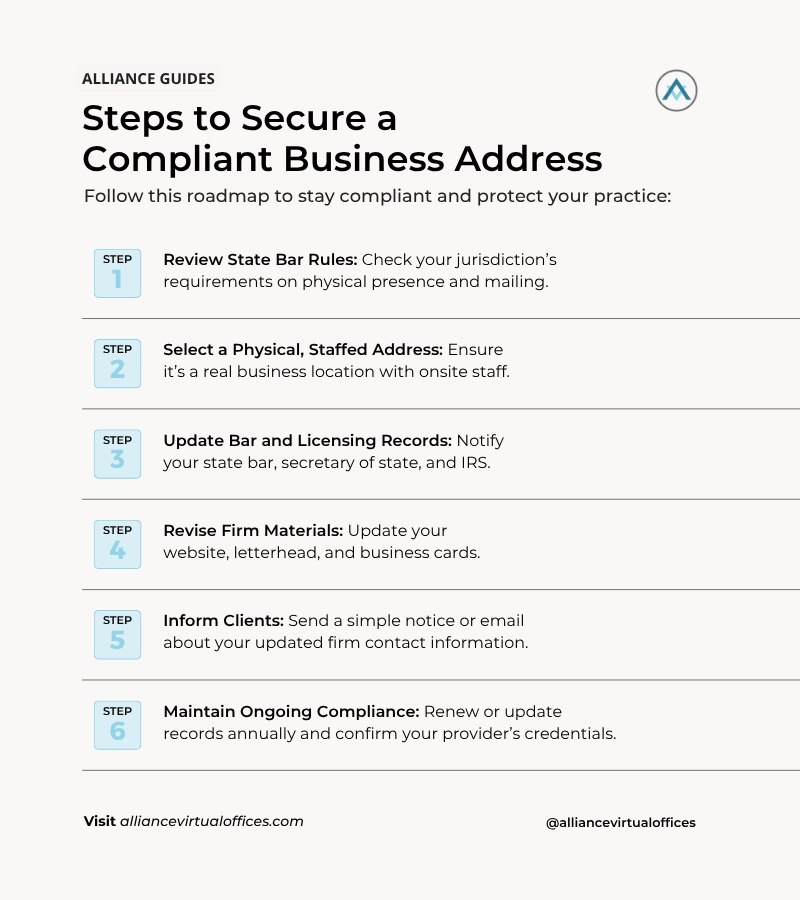
Next Steps to a Compliant, Professional Law Firm Presence
Maintaining a compliant, ethical, and professional business address for your law firm is more than a checkbox; it’s a statement of integrity and trust.
Whether you’re launching a new solo practice or expanding across states, your address shapes how clients and regulators perceive your firm.
Don’t compromise your professionalism or privacy.
Explore virtual business address solutions that meet state bar standards, powered by Alliance Virtual Offices.
👉 Get started with a compliant business address today.


