
- Compliance for CPAs, Consultants & Advisors
- Best Practices for Regulatory Adherence
- How Alliance Virtual Offices Supports Compliance
Q: Can professional services firms use a virtual office and remain fully compliant with licensing and regulatory requirements?
A: Yes. CPAs, consultants, and advisors can use a virtual office compliantly, provided they choose a provider with a real, verifiable street address, secure mail handling, and the infrastructure to support professional licensing and client confidentiality requirements. The key is selecting the right provider and pairing it with clear internal policies.
The Compliance Challenge Facing Professional Services Today
The professional services industry is no stranger to strict regulatory oversight. CPAs, financial advisors, management consultants, and legal professionals operate under layers of licensing requirements, ethical codes, and client confidentiality obligations.
So when these same professionals begin exploring virtual offices, a critical question arises: can a virtual address actually meet the bar?
The short answer is yes, and more firms are proving it every year. According to a 2023 report by Global Workplace Analytics, over 56% of knowledge workers now operate in hybrid or fully remote arrangements. For professional services firms, this shift has accelerated the adoption of virtual office solutions as a practical, cost-effective alternative to traditional office leases.
But flexibility without compliance is a liability. Understanding what virtual office compliance means for your profession is not optional; it is foundational to protecting your license, your clients, and your reputation.
NEXT STEPS: New to virtual offices? Start with Alliance Virtual Offices to explore address options across all 50 states.
Understanding Virtual Office Compliance
What Is a Virtual Office in a Professional Context?
A virtual office provides businesses with a real, physical business address along with supporting services such as mail handling, phone answering, and access to meeting rooms, without requiring a dedicated, full-time physical space.
For professional services firms, this distinction matters enormously. A virtual office is not a P.O. box, and it is not a residential address. It is a legitimate business address that can be used for state licensing, client correspondence, regulatory filings, and official communications.
“A virtual office is not a workaround; it is a legitimate infrastructure choice, provided it is set up with compliance in mind.”
The Regulatory Landscape
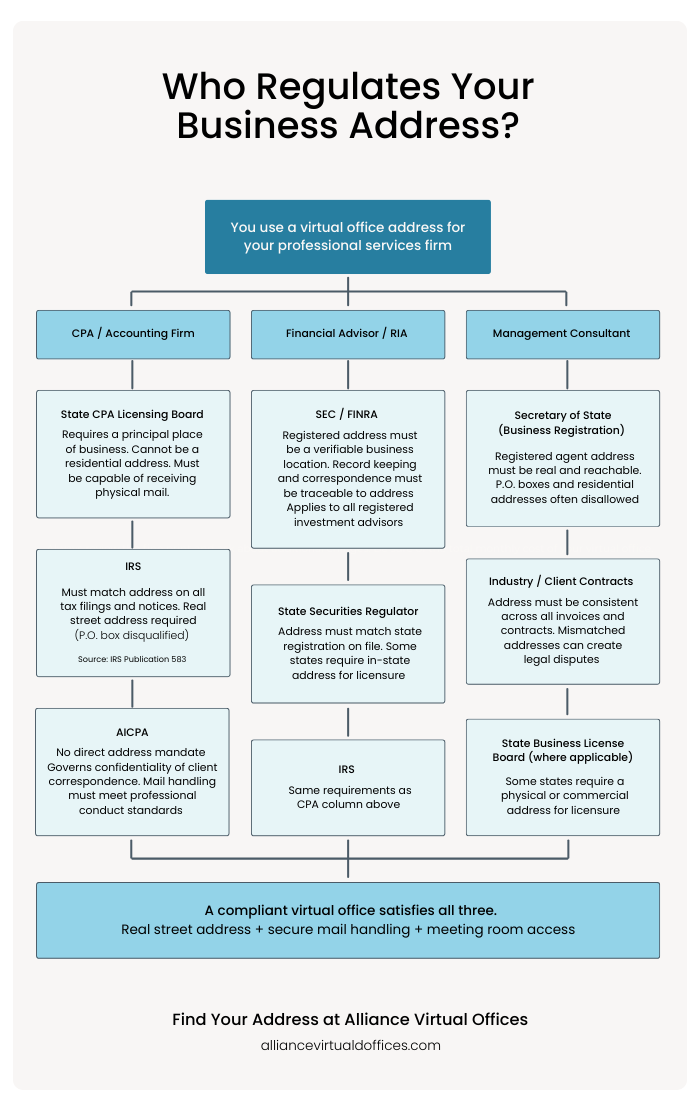
Professional services operate under multiple overlapping frameworks. Depending on your field, your virtual office address may be reviewed by:
- State licensing boards (for CPAs, financial advisors, and consultants)
- The IRS (for registered business address requirements)
- The SEC or FINRA (for registered investment advisors)
- Professional conduct bodies such as the AICPA
The core risk of non-compliance is not simply a fine. It can mean the suspension or revocation of your professional license. Understanding how your specific regulatory environment treats virtual business addresses is the first and most important step.
NEXT STEPS: Considering your state for registration? Read our guide on the best state for your LLC before committing to an address.
Compliance Considerations by Profession
For CPAs: Licensing, Ethics, and the IRS
Business Address and IRS Requirements
The IRS requires that a business address on file be a verifiable location capable of receiving official correspondence. Per IRS Publication 583, businesses must maintain accurate address records for tax filings, notices, and audits. A compliant virtual office with a real street address satisfies this requirement; a P.O. box does not.
State CPA Licensing
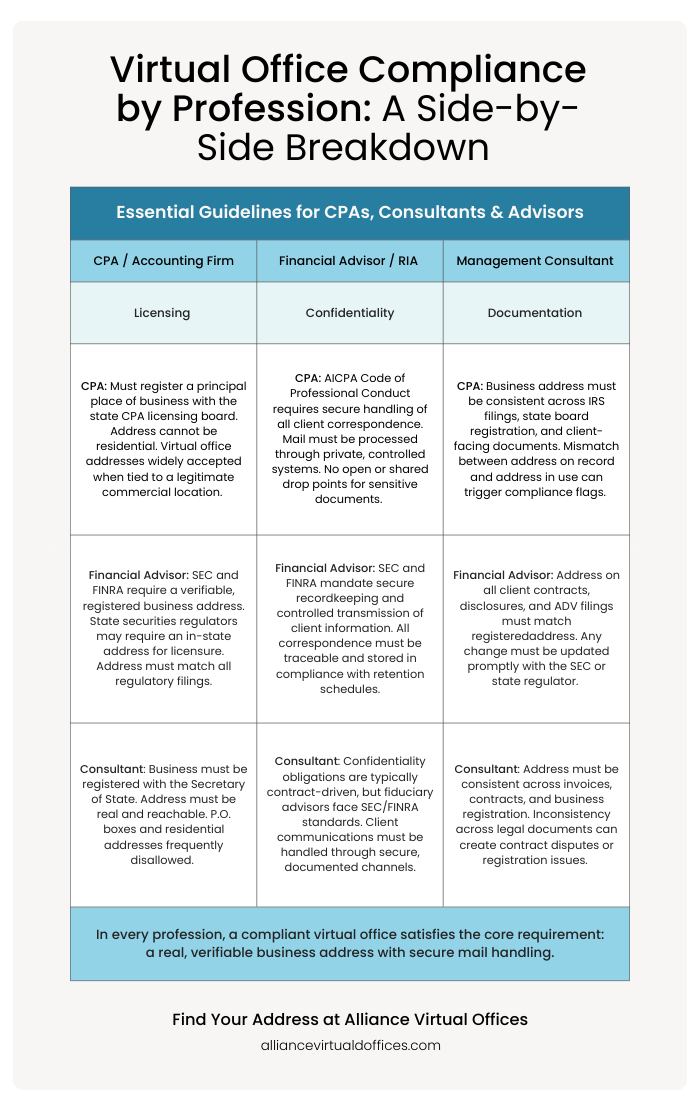
CPA licensing is regulated at the state level, and requirements vary. Most state boards require a principal place of business address that is not a personal residence. Many explicitly allow virtual office addresses, provided the address is tied to a legitimate office service provider that can receive correspondence and verify the business’s existence.
Before registering, confirm your state board’s language around “principal office” or “place of business.” Some states require the address to be capable of receiving physical mail on behalf of the licensee, which aligns directly with what a reputable virtual office provides.
AICPA Code of Professional Conduct
The AICPA Code of Professional Conduct places significant weight on client confidentiality and the safeguarding of client information. For CPAs using virtual offices, this means:
- Ensuring client correspondence is handled through secure, private mail systems
- Avoiding shared or unsecured drop boxes for sensitive documents
- Using private meeting rooms for any in-person client engagement where confidential information is discussed
“A member in public practice shall not disclose any confidential client information without the specific consent of the client.” — AICPA Code of Professional Conduct, ET Section 1.700.001
NEXT STEPS: Explore how secure mail handling works at Alliance Virtual Offices, including options for mail forwarding and digital scanning.
For Consultants and Advisors: Registration, Fiduciary Duty, and Documentation
Business Registration and Licensing
Management consultants and business advisors typically operate under fewer licensing mandates than CPAs, but business registration requirements still apply. Your registered agent and business address must be valid, reachable, and in good standing with your state’s Secretary of State office.
Using a virtual office address for state registration is widely accepted, provided the address is a real physical location with mail handling capabilities. This is a meaningful distinction from residential or P.O. box addresses, which many states disallow for business registration purposes.
Fiduciary and Confidentiality Standards
For financial advisors operating under fiduciary duty, client confidentiality is not just an ethical obligation; it is a legal one. The SEC and FINRA require that registered investment advisors maintain secure recordkeeping practices, including the storage and transmission of client information.
A virtual office supports this when it provides:
- Private, secure mail receipt and handling
- On-demand access to private meeting rooms for client-facing engagements
- A consistent, professional business address for all client-facing documentation
Contracts, Invoicing, and Legal Documentation
A common question for consultants is whether a virtual office address can be used on contracts and invoices. The answer is yes, with one caveat: the address must match your registered business address on file with the state. Consistency across all legal and financial documents is critical to avoiding disputes or compliance flags.
“For advisors operating under fiduciary duty, the question is never just ‘is this allowed?’ It is ‘does this protect my clients and my practice?'”
NEXT STEPS: Find the best cities for financial advisors and CPAs to position your practice in the right market.
Best Practices to Ensure Regulatory Adherence
Getting the right virtual office address is step one. Staying compliant over time requires consistent internal discipline.
1. Choose a Provider with Real, Verifiable Addresses
Not all virtual office providers are equal. Choose one that offers real street addresses at legitimate commercial locations, not repackaged P.O. boxes. Confirm that the provider is recognized and can receive USPS, FedEx, and UPS deliveries on your behalf.
2. Keep Your Business Address Separate from Your Residence
Using a home address for a professional services firm creates several risks: limited privacy, potential licensing issues, and reduced credibility with clients and regulators. A dedicated business address through a virtual office solves all three.
3. Implement Internal Document and Communication Policies
Define how client correspondence, contracts, and sensitive documents are handled within your firm. This should cover:
- Who is authorized to retrieve and open mail
- How digital document storage is organized and secured
- What protocols govern sharing client information via email or cloud systems
4. Schedule Regular Compliance Audits
Regulations change, and so do your business needs. Set a calendar reminder to review your virtual office setup at least once a year. Confirm that your address is still in good standing with your licensing board, your IRS records are current, and your mail handling procedures remain secure.
5. Use Meeting Rooms for Client-Facing Engagements
When compliance or client relationships require in-person interaction, having access to professional meeting rooms is essential. This is especially relevant for CPAs conducting client reviews, advisors presenting financial plans, and consultants facilitating workshops.
Virtual office compliance is not a one-time setup task. It is an ongoing operational commitment that reflects your firm’s standards for professionalism and client care.
NEXT STEPS: Ready to set up a compliant address? Book a virtual office with Alliance Virtual Offices and get started today.
How Alliance Virtual Offices Supports Compliance
Alliance Virtual Offices is built with the needs of professional services firms in mind. Here is how the platform directly supports regulatory adherence.
Real Business Addresses Across All 50 States
Every Alliance address is a real, physical commercial location, fully capable of receiving official mail from the IRS, state licensing boards, and regulatory agencies. This is the baseline requirement for professional services compliance, and Alliance meets it across hundreds of locations nationwide.
Secure Mail Handling and Forwarding
Client correspondence and regulatory notices require careful handling. Alliance provides secure mail receipt, with options for physical forwarding or digital scanning so you can access documents quickly without compromising confidentiality. Learn more about secure mail handling.
On-Demand Meeting Rooms
Whenever a client engagement requires privacy or an in-person setting, Alliance’s network of meeting rooms provides professional, bookable spaces on demand. This is particularly valuable for CPAs conducting sensitive reviews, advisors presenting financial documentation, and consultants facilitating strategy sessions.
Live Receptionist Services
A live receptionist answers calls under your business name, providing a professional client experience without requiring a full-time front desk. This feature reinforces your firm’s credibility and ensures client inquiries are handled with care.
Together, these features create a compliance-supportive infrastructure that lets professional services firms operate flexibly without cutting corners on regulatory requirements.
Your Next Step Toward a Compliant Virtual Office
Virtual office compliance for professional services is not a gray area. It is a manageable, well-defined set of requirements that any CPA, consultant, or advisor can meet with the right provider and the right internal policies.
The shift toward remote and hybrid work is not slowing down. Firms that understand how to operate compliantly within that shift will be better positioned to serve clients, maintain licensure, and grow with confidence.
Alliance Virtual Offices provides the address, the infrastructure, and the services that make virtual office compliance straightforward for professional services firms of every size.
NEXT STEPS: Book a compliant virtual office or speak with an Alliance team member about the best setup for your firm.