


- Can CPAs Use a Virtual Address?
- Why CPA Firm Address Rules Matter
- Federal vs. State Regulations for CPA Firm Addresses
- State-by-State CPA Virtual Address Rules (2025 Update)
Q: Can a CPA use a virtual address as a firm’s official business address?
A: Yes! In most cases, a CPA can use a virtual address as the firm’s official business address, but the key is how that address functions and whether it satisfies state-specific compliance rules.
A virtual address for CPAs refers to a real, commercial office location operated by a professional service provider. It’s staffed during business hours and capable of receiving mail, storing or forwarding documents, and providing on-demand meeting space when needed. These qualities make it fundamentally different from a P.O. Box or mailbox rental, which are not recognized as compliant business addresses under most state CPA board rules.
For certified public accountants, compliance and professionalism are inseparable. Yet maintaining a traditional office isn’t always practical, especially for CPAs who now operate remotely, serve clients across states, or manage boutique firms on lean budgets.
This practical guide explains how CPA firm address requirements work at both the federal and state levels, where virtual offices fit into compliance, and what every accountant should know before listing a virtual address on licensing or client materials. It also outlines how Alliance Virtual Offices supports CPAs with compliant, professional business addresses in all 50 states.
Unlock Our Current Virtual Office Offers
Enter your email below and we’ll send you the latest available promotions and monthly specials for Virtual Offices, Meeting Rooms, and Live Receptionists.
Can CPAs Use a Virtual Address?
Short answer: Yes. A virtual address is a legitimate street address at a staffed commercial office where your firm’s mail is received, processed, and forwarded. Unlike a P.O. Box or UPS Store, a virtual office location is managed by on-site personnel and can typically provide proof of occupancy, secure mail handling, and optional meeting-room access.
Many CPAs use virtual addresses to:
- Register their firm or sole proprietorship.
- Receive client correspondence and tax notices.
- Maintain professional credibility while working remotely.
- Protect personal privacy by avoiding home-address disclosure.
Federal agencies such as the IRS allow business correspondence to be sent to any valid street address. However, state boards of accountancy may impose additional standards because licensing rules are designed to protect the public.
Understanding the difference between federal flexibility and state-level oversight is the key to compliance.

Why CPA Firm Address Rules Matter
Your firm’s official address does far more than collect mai-it serves as the foundation of your professional identity, credibility, and regulatory standing.
For licensed accountants, the business address represents where the firm conducts its core operations, maintains client records, and satisfies regulatory oversight. In the eyes of clients, state boards, and auditors, it defines your principal place of business.
Each state board of accountancy expects CPAs and CPA firms to provide an address that reflects an actual place of business-not a temporary or anonymous mailbox.
Understanding why this matters is essential to maintaining both compliance and client trust.
Compliance and Licensing
Every CPA license is tied to a specific jurisdiction, and that jurisdiction must be able to contact and, if necessary, inspect the firm’s designated address. Most states explicitly require that CPAs list a physical or commercial business address on license applications, renewals, and firm registrations.
Failing to maintain a compliant address-such as by using a P.O. Box, UPS Store, or unstaffed mail drop-can create regulatory issues. Some boards may suspend renewals or issue disciplinary action if a licensee cannot demonstrate a verifiable business location or access to firm records.
A compliant CPA virtual office address, on the other hand, satisfies these requirements by providing a staffed, commercial environment suitable for correspondence and official notices.
Professional Reputation
A CPA’s address also plays a significant role in public perception. Clients, financial institutions, and regulatory agencies look for consistency and credibility in a firm’s business presentation.
Displaying a home address on financial statements, engagement letters, or your website can inadvertently undermine your professional image. It signals a lack of separation between personal and business operation-something that can raise doubts about confidentiality, scalability, or legitimacy.
By contrast, using a virtual address for CPAs from a reputable provider associates your firm with a credible business district or office tower. It communicates stability, professionalism, and attention to client expectations.
Client Privacy and Data Security
Accounting professionals routinely handle sensitive financial information-tax returns, payroll data, bank statements, and personally identifiable client details. Delivering or storing such documents at a residential address introduces unnecessary privacy risks.
A staffed professional office ensures controlled mail handling, document security, and limited access by unauthorized parties. It also creates a clear boundary between home and work, reinforcing the ethical obligation CPAs have to protect client confidentiality.
For firms using a virtual office for professionals, this security layer is built in: mail is received, logged, and stored in a secure business environment until the CPA collects or forwards it.
Legal Recordkeeping and Accountability
From a compliance standpoint, the business address provides a verifiable point of contact for audits, subpoenas, or other legal correspondence. In many states, a CPA must be able to produce firm records upon request from the board or other regulators.
Maintaining a traceable, verifiable business address demonstrates organizational diligence and supports proper documentation of client engagements, firm policies, and regulatory filings. It can also protect CPAs during disputes by providing a clear paper trail that aligns with state and federal recordkeeping requirements.
In short, the firm’s address is a legal and reputational ancho-linking your practice to its professional obligations. Choosing a compliant, staffed, and secure location is not only a regulatory requirement but also a hallmark of good business governance.
Federal vs. State Regulations for CPA Firm Addresses
At the federal level, entities such as the Internal Revenue Service and Securities and Exchange Commission accept a wide range of mailing addresses for correspondence.
As long as the address is legitimate, you can use a home, rented, or virtual location on federal filings.
At the state level, oversight is much tighter. Every board of accountancy defines its own criteria for a principal place of business, which is the official address associated with a CPA license or firm registration.
Common expectations include:
- The address must represent a real, physical location-not a mailbox rental or P.O. Box.
- Licensees must have access to client files and firm records at that address or on request.
- The location should allow for inspection or contact during business hours.
Because boards interpret these requirements differently, CPAs must confirm local rules before designating a virtual office as their firm’s address.
State-by-State CPA Virtual Address Rules (2025 Update)
States generally fall into three categories: those that allow virtual addresses, those that allow them with restrictions, and those that require an in-state physical office.
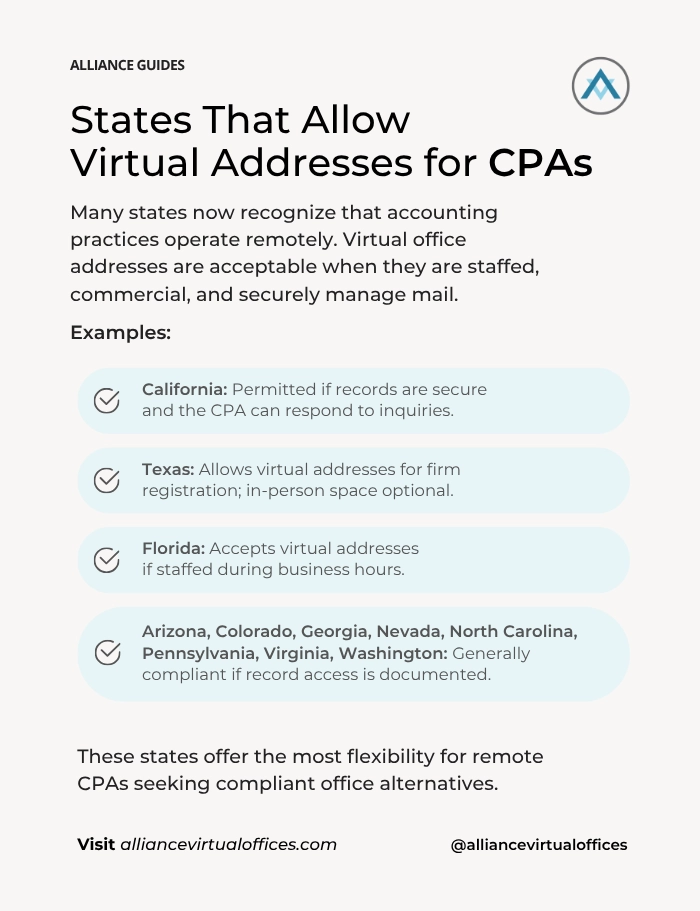
B. States That Allow Virtual Addresses with Restrictions
Some boards permit virtual addresses only if additional conditions are met-such as proof of lease or demonstration that records can be inspected.
Examples:
- New York – Requires a valid business address for regulatory communication. Virtual addresses are acceptable if mail can be received and records are accessible for board review.
- New Jersey – Allows virtual addresses when accompanied by a formal service agreement or lease that identifies the occupant.
- Illinois – Permits remote operation but expects licensees to provide access to physical records upon request.
- Massachusetts, Ohio, Oregon, Minnesota, Maryland – Evaluate on a case-by-case basis; CPAs must demonstrate that the address satisfies “principal place of business” requirements.
In these states, documentation is critical. Keep your virtual-office agreement, receipts, and contact details available for audit verification.
C. States That Require a Physical Office Presence
A smaller group of states still mandates that CPAs maintain an in-state office where professional services are managed.
Examples:
- Alabama – The Board requires a physical business location within the state for in-state licensure.
- South Dakota, North Dakota, Wyoming, Montana – Expect licensees to maintain a tangible office accessible for record review.
- Louisiana, Mississippi – Require fixed, dedicated offices to serve as the firm’s principal location.
Even in these states, CPAs may still use virtual addresses for mail forwarding or marketing, but the official licensing address must meet physical-presence standards.
(Because regulations change frequently, verify with your state board of accountancy before filing new applications or renewals.)
Benefits of a Virtual Address for CPAs
While state-by-state compliance requirements vary, the business advantages of a professional virtual address remain consistent across the accounting industry.
For many small to mid-sized firms, a virtual office provides the right balance between regulatory compliance, professional image, and cost efficienc-especially in an era when clients increasingly expect flexibility and digital accessibility.
Below are the primary benefits of adopting a CPA virtual address for your practice.
1. Professional Credibility and Client Confidence
A CPA’s reputation depends on visibility, consistency, and trust. Clients, lenders, and regulators all associate a firm’s address with its credibility. Listing a home address or unstaffed location can raise doubts about professionalism or operational stability.
A virtual address for CPAs instantly enhances perception by placing your firm within a recognized business district or office tower. This not only strengthens first impressions but also supports your online presence across Google Business Profile, CPA directories, and marketing materials.
Professional virtual offices also allow CPAs to maintain consistent brandin-using a single business location across tax filings, engagement letters, and correspondence-which reinforces your firm’s reliability and professionalism.
2. Cost Efficiency Without Sacrificing Compliance
Traditional office leases often include high overhead costs-rent, utilities, equipment, cleaning, and administrative staffing. For a small firm or solo CPA, those expenses can consume a significant share of annual revenue.
A virtual office for professionals provides the essential-business address, mail handling, meeting rooms, and receptionist suppor-at a fraction of that cost.
This model enables accountants to maintain a legitimate principal place of business that satisfies CPA firm address requirements without committing to a long-term lease.
The savings can be reinvested into growth areas such as technology, continuing education, and client service upgrades, rather than real estate.
3. Nationwide Reach and Local Presence
Many accounting firms operate across multiple jurisdictions, serving clients remotely in various states.
Establishing a physical office in each state is rarely practical-but using multiple CPA virtual addresses can achieve the same local presence for compliance and marketing purposes.
Alliance Virtual Offices, for example, allows CPAs to select professional business addresses in all 50 states. This makes it easier to:
- Register foreign entities or branch offices where required.
- Expand client bases into new regions.
- Build local SEO visibility in targeted markets.
This flexibility supports both regional expansion and remote-service business models while staying aligned with state CPA board rules for office addresses.
4. Data Privacy and Personal Security
Accounting professionals handle confidential tax, payroll, and financial information daily. Using a home address for your firm exposes personal data to the public and increases risks of unsolicited contact or identity theft.
A virtual address for CPAs separates business from personal life-keeping your residential information private while ensuring mail is handled securely. Most virtual office providers have mail management protocols that meet professional confidentiality standards, with secure storage, forwarding, and shredding options.
This is not only a best practice for privacy but also aligns with CPA licensing compliance and ethical standards surrounding the protection of client information.
5. Operational Flexibility and Modern Workflow
A modern accounting firm thrives on mobility. With cloud-based software and digital records, CPAs can serve clients efficiently from virtually anywhere-but a stable business address still anchors operations for compliance and credibility.
A CPA virtual office bridges that gap by combining digital accessibility with physical infrastructure. Services often include:
- Mail forwarding and document scanning, allowing you to receive important client materials in real time.
- On-demand meeting rooms and conference spaces for audits, consultations, or team collaboration.
- Administrative and receptionist support, ensuring clients always have a reliable point of contact.
This model enhances productivity while eliminating unnecessary administrative overhead, allowing firms to focus on advisory services and client outcomes rather than office management.
6. Scalability for Growing Firms
As a CPA practice grows, so do its operational needs. A virtual office offers a scalable foundatio-you can start with a single location for compliance and client mail, then add new addresses as your client base or team expands into additional states.
This scalability supports the long-term vision of many firms transitioning to remote-first or hybrid accounting models. By establishing compliant virtual offices in strategic markets, CPAs can serve clients nationwide while maintaining consistent standards of professionalism and accessibility.
7. Competitive Advantage in a Hybrid Work Era
The accounting industry continues to shift toward hybrid and remote service delivery. Clients no longer expect to meet their CPAs exclusively in person, but they still value the reassurance of knowing their accountant operates from a credible business location.
A CPA virtual office offers that balanc-digital convenience paired with tangible presence. Firms that adopt flexible workspace solutions signal adaptability and forward-thinking professionalism, traits that differentiate them in a competitive marketplace.
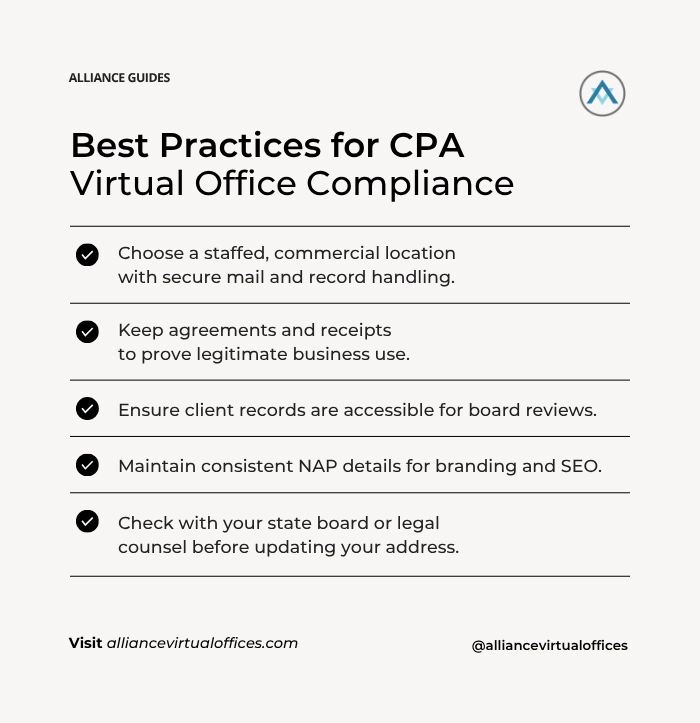
Following these steps demonstrates proactive compliance and reduces risk of disciplinary action.
How Alliance Virtual Offices Supports CPAs
Alliance Virtual Offices helps accountants and CPA firms maintain compliance while optimizing operations.
Each Alliance location is a staffed, commercial business center-not a mailbox facilit-making it suitable for regulated professionals.
What CPAs Receive with an Alliance Virtual Office
- A professional business address recognized for licensing, correspondence, and branding.
- Mail receipt, secure storage, and forwarding services that maintain confidentiality.
- Access to meeting and conference rooms for client appointments or audits.
- Optional live receptionist support for inbound calls and client scheduling.
- Nationwide coverage across all 50 states to support multi-state practices.
Compliance-Ready by Design
Alliance’s network aligns with CPA firm address requirements and state board of accountancy regulations. Each address functions as a verifiable, staffed location, meeting the criteria of a legitimate principal place of business for CPAs.
Whether you are launching a remote accounting practice, downsizing from leased space, or expanding into new markets, Alliance provides a virtual office for professionals that satisfies both operational and regulatory expectations.
For details on how to match a location to your specific state requirements, consult Alliance Virtual Offices’ compliance team or refer to our in-depth guide, Virtual Office State Laws Explained.
Practical Steps to Stay Compliant
Navigating compliance as a CPA doesn’t have to be complicated-but it does require precision.
Each state board of accountancy has its own interpretation of what qualifies as an acceptable principal place of business, which means that even small oversights can delay renewals or trigger regulatory questions.
Whether you’re switching from a leased office to a CPA virtual address or launching a new firm, the goal is to establish clear documentation and ensure consistency across every record tied to your practice.
The following checklist outlines the essential steps for CPA licensing compliance when using a virtual or remote office model.
- Review Your State’s Rules
Visit your board of accountancy website to verify address requirements. The AICPA maintains an updated directory of board links.
- Choose a Qualified Provider
Select a provider offering commercial, staffed office locations-not mailbox stores. Alliance Virtual Offices specializes in addresses recognized by state and federal authorities.
- Update Your Records
After obtaining a virtual address, update your CPA license, firm registration, IRS EIN record, and Google Business Profile to reflect consistent information.
- Maintain Documentation
Keep copies of your lease, mail-handling instructions, and communications confirming your right to use the address.
- Plan for Inspections or Correspondence
Ensure you can access or retrieve mail promptly and provide documentation if your board requests verification.
Compliance isn’t a one-time event; it’s an ongoing part of firm management. Once your CPA firm address requirements are met, maintain good habits by reviewing them annually or whenever your business expands into new states.
Choosing a qualified virtual office provider-like Alliance Virtual Office-simplifies this process by ensuring every address you use is staffed, verifiable, and aligned with state board of accountancy regulations.
By keeping documentation current and communication channels open, you’ll safeguard your license, strengthen client trust, and operate confidently across jurisdictions.
Further Reading:
- Virtual Business Address for LLCs vs Home Address
- Can I Use a Virtual Address for My LLC?
- Virtual Office for Accountants: 5 Benefits
- Registered Agent vs Virtual Office
Choose A Smart Virtual Address & Stay Compliant
A virtual address can serve as an efficient, professional, and compliant solution for today’s CPAs-provided it meets your state’s definition of a principal place of business.
When evaluating options, distinguish between simple mailboxes and staffed commercial offices that satisfy state CPA board rules office address criteria. Partnering with a provider experienced in professional compliance gives you confidence that your firm meets licensing standards while operating flexibly.
Alliance Virtual Offices enables accountants to maintain credibility, protect privacy, and operate efficiently nationwide.
Before you finalize your registration, verify your board’s latest guidance and choose a virtual address that aligns with both CPA licensing compliance and your long-term business goals.
Find a CPA-Compliant Virtual Office Address Near You → Explore Locations
Learn More
- AICPA – State Boards of Accountancy Directory
- IRS – Business Address Filing Guidelines
- State Board of Accountancy websites (consult your state for the latest policies)


