- Do You Need a CDL to Drive a Box Truck?
- Steps to Start a Non-CDL Box Truck Business
- How to Find Box Truck Loads and Contracts
Q: How do you start a box truck business?
A: To start a box truck business, pick a niche, get a truck rated under 26,001 lbs GVWR so no CDL is needed, and form an LLC with an EIN. Then register with FMCSA if your routes require it, buy the right insurance, and line up your first loads.
If you’re researching how to start a box truck business, you’ve probably noticed the advice is scattered. One video says you need a huge budget, another says you can start with nothing, and few of them explain the license question up front.
Most box trucks can be driven on a standard driver’s license, which keeps the barrier low for a new owner-operator. The paperwork is manageable if you take it in order, and that includes forming your LLC and using a business address for state LLC filings before you chase your first contract.
Demand is on your side. Pitney Bowes’ Parcel Shipping Index counted 23.1 billion U.S. parcel shipments in 2025, up 3.3% from the year before, and those parcels don’t deliver themselves.
Do You Need a CDL to Drive a Box Truck?
No, not for most box trucks. Under FMCSA’s CDL classification rules, a Class B commercial driver’s license is required for a single vehicle with a gross vehicle weight rating (GVWR) of 26,001 lbs or more. Most box trucks used for non-CDL work are rated below that line, so a standard license covers them.
GVWR is the maximum loaded weight the manufacturer says the truck can safely carry, including the truck itself. You’ll find it on the sticker inside the driver’s door, and that rating decides the license question, whatever you happen to load on a given day.
Truck length is only a rough guide. Many 16-foot to 26-foot box trucks are built under the 26,000-lb line, but some 26-foot models are rated above it, so check the door sticker before you sign anything.
A few situations require a CDL regardless of weight. According to FMCSA’s CDL license classes, a Class C license applies if you haul hazardous materials that must be placarded or if the vehicle is designed to carry 16 or more passengers, including the driver.
States can add their own rules, so confirm with your state DMV before you buy.
That five-minute call is cheaper than a truck you can’t legally drive.
Steps to Start a Non-CDL Box Truck Business
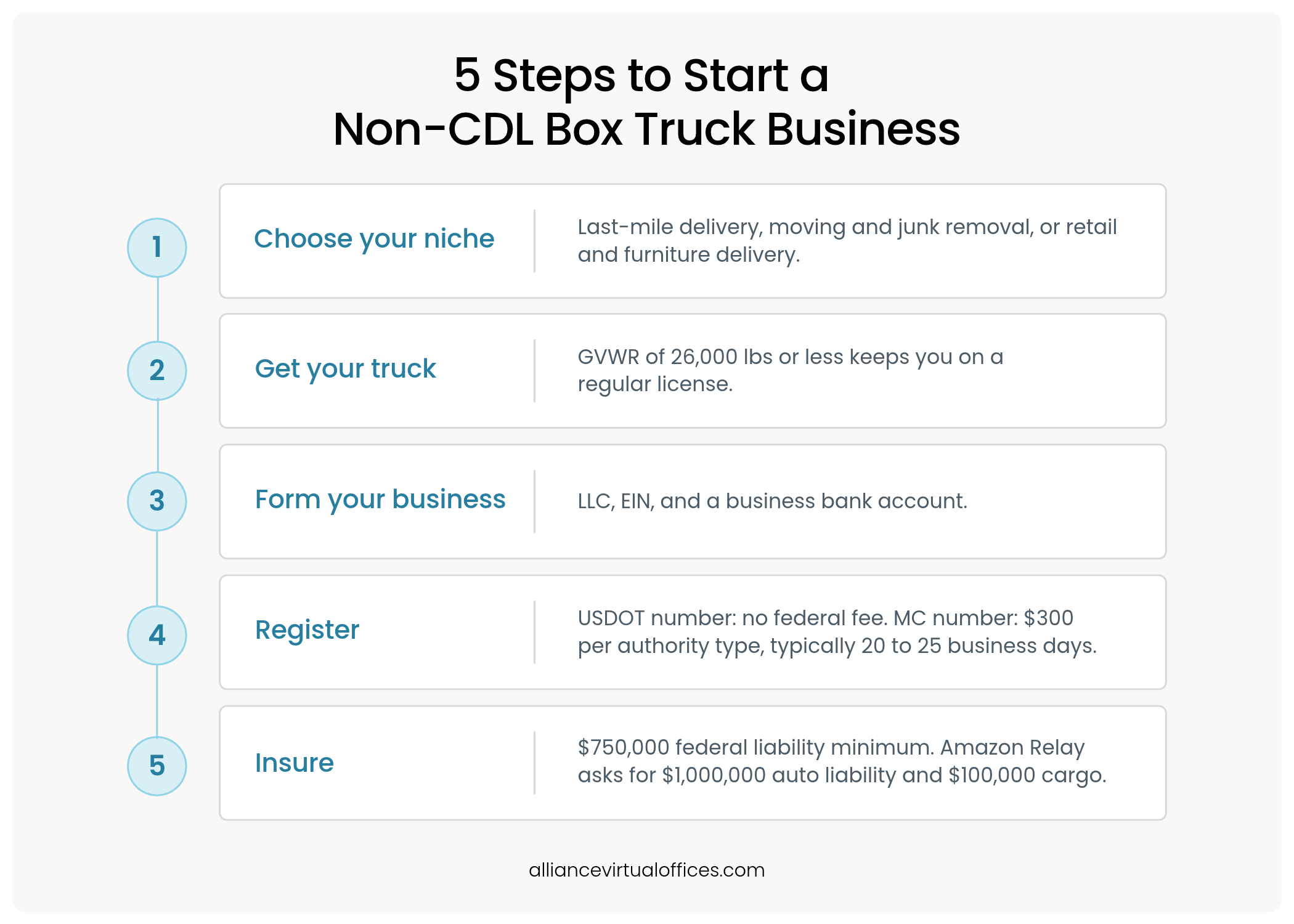
Doing these steps in order keeps you from paying for things twice. Registration depends on your business entity, insurance depends on your registration, and most contracts depend on all three.
- Choose your niche
- Get your truck
- Form your business
- Register for a USDOT number and operating authority
- Get box truck insurance
Step 1: Choose your niche
Your niche decides your truck, your insurance, and your customers, so pick it first. Three common paths for a non-CDL box truck business are last-mile delivery, local moving and junk removal, and retail or furniture delivery for local stores.
Last-mile work tends to mean steady, scheduled routes with tight time windows. Moving and furniture delivery can pay more per job but need helpers, liftgates, and a strong local reputation.
Step 2: Get your truck
Most new operators choose between buying used, financing new, or box truck leasing. Buying gives you equity, while leasing keeps upfront cash lower and often bundles maintenance, which matters when one breakdown can wipe out a week of income.
Many one-truck operations start with a used truck. Ask for maintenance records, check the tires, brakes, and liftgate, and pay a diesel or truck mechanic for an inspection before you hand over a deposit.
Leasing trades ownership for predictability. Read the mileage allowance, the maintenance terms, and the early termination clause, because a cheap monthly payment can turn expensive if your routes run longer than you planned.
Before you commit, confirm the GVWR is 26,000 lbs or less, the truck has a working liftgate if your niche needs one, and the box length fits the loads you plan to haul.
Step 3: Form your business
Form an LLC before you sign a lease or a contract. An LLC can help separate business debts and claims from your personal assets, and it gives shippers and brokers a registered company to vet.
Next, get a free Employer Identification Number (EIN) from the IRS and open a business bank account.
When you file, the state will usually ask for a principal business address, and Alliance’s guide to a virtual business address for an LLC explains what to check before you list one. Address requirements vary by state and entity type, so confirm them with your Secretary of State before you submit.
Step 4: Register for a USDOT number and operating authority
Registration trips up a lot of new owners, so take it slowly. According to FMCSA’s USDOT number requirements, you need a USDOT number if your vehicle has a GVWR of 10,001 lbs or more and you operate in interstate commerce.
Most box trucks clear that weight, and interstate commerce includes freight that started or will end in another state, even if your own route stays local.
Some states require a USDOT number for intrastate work too. FMCSA lists 38 states plus Puerto Rico with that rule, including California, Texas, Florida, and New York.
If you’ll haul other people’s regulated freight across state lines for pay, you’ll also need operating authority, usually identified as an MC number. FMCSA’s operating authority page lists a $300 fee per authority type and a typical processing time of 20 to 25 business days for new applicants, though applications pulled for further review can take 8 weeks or longer.
Drivers covered by FMCSA rules also need a medical examiner’s certificate from a provider on the FMCSA National Registry. According to FMCSA’s DOT medical exam guidance, a DOT physical is valid for up to 24 months.
Step 5: Get box truck insurance
Insurance is usually one of the largest recurring costs after the truck itself. For-hire interstate carriers of general freight in vehicles of 10,001 lbs or more must carry at least $750,000 in bodily injury and property damage liability, according to FMCSA’s insurance filing requirements.
That figure is the federal floor, and many customers expect more. Amazon Relay’s carrier FAQ, for example, asks for $1,000,000 per occurrence in auto liability and at least $100,000 in cargo coverage, so price your policy against the contracts you want.
Most box truck owners end up with several coverages. Ask your agent to quote each of these so you can compare policies line by line:
- Auto liability: covers injury and damage you cause to others on the road, and is the coverage FMCSA’s minimum applies to.
- Motor truck cargo: covers the freight you’re hauling if it’s damaged or stolen.
- Physical damage: covers your own truck, and lenders and leasing companies usually require it.
- General liability: covers claims that happen off the road, such as damage inside a customer’s home during a delivery.
- Workers’ compensation: required in most states once you hire helpers or drivers.
Shop at least two or three commercial insurers that write trucking policies. A clean driving record and a defined operating radius usually help your quote.
How Much Does It Cost to Start a Box Truck Business?
It depends on the truck, your state, and your driving record. You can still price every line item before you commit, so nothing surprises you later.
Plan working capital carefully. Brokers and shippers often pay on net terms, so you may cover fuel and insurance for weeks before the first payment lands.
Starting with “no money” usually means starting with someone else’s money. Leasing and financing lower the cash you need on day one, but lenders will still look at your credit, and a business credit file can help.
Read More: Build Business Credit With a Virtual Office
How to Find Box Truck Loads and Contracts
A registered, insured truck earns nothing until it’s loaded. Finding box truck contracts is where your niche choice from Step 1 pays off, because each source suits a different kind of operator.
Freight platforms like Amazon Relay
Amazon Relay is a load board that lists freight for 16-foot and 26-foot box trucks with tuck-under liftgates. Amazon Relay’s carrier FAQ says it typically requires a DOT number with interstate authority that has been active for at least 180 days, a valid MC number, and a Satisfactory, None, or Not Rated safety rating.
Plan around that 180-day window. Amazon encourages carriers to apply early, so many new carriers submit an application and take other work while their authority ages.
Amazon’s Delivery Service Partner program (Amazon DSP) often comes up in the same breath, but it’s a different model built around Amazon-branded delivery vans. Treat it as a separate business to research rather than a load source for your own box truck.
App-based delivery networks
Apps such as GoShare connect box truck owners with local moving and delivery jobs. GoShare’s driver requirements call for a 2004 or newer vehicle that passes inspection, a background and driving history check, and valid license, registration, and insurance in your state.
These apps are useful for filling gaps in your schedule. They rarely replace a steady contract, but they can cover fixed costs while you build one.
Load boards and freight brokers
Load boards such as DAT and Truckstop list freight from brokers who need trucks. Brokers will check your authority, insurance certificate, and safety record before they book you, so keep those documents current and easy to send.
Before you accept a load, read the rate confirmation closely. Check the pickup and delivery windows, any detention or liftgate fees, and the payment terms, then compare the rate against your real cost per mile, including the empty miles back home.
Local retailers and furniture stores
Local contracts can be the steadiest work for a one-truck operation. Furniture stores, appliance dealers, and building supply companies often hire outside carriers for delivery.
Walk in with a one-page rate sheet, proof of insurance, and a clear service area. A store manager mostly wants to know you’ll show up on time and handle their customer’s couch with care.
Get Your FREE Guide Today!
How to Start a Business in a Recession
Running the Business and Looking Contract-Ready
Once loads start coming in, the work shifts to keeping your records clean. Run every dollar through the business bank account and use simple bookkeeping software, so tax time and loan applications don’t turn into a shoebox of receipts.
Track every fuel receipt and maintenance invoice, keep your insurance certificate current, and use a simple dispatch calendar so you don’t double-book a delivery window.
Set aside a few hours each month for compliance. Renew registrations on time, keep your medical certificate current, and file vehicle inspection and repair records in one folder, because brokers and auditors may ask for them.
Shippers and brokers vet carriers before they hand over freight. They look at your registrations, your insurance, and whether your business looks like it’ll still be answering the phone next month.
Why your address and phone number matter
Much of a carrier’s first impression comes from the address on your filings, the number on your rate sheet, and who picks up when a dispatcher calls. A home address and a personal cell phone work, but they mix your private life into every document you send.
A Virtual Office from Alliance includes a professional business address at a staffed location, with mail handling. Put it on your rate sheet and broker packets, and keep your home address off the documents you send out.
You may also be able to use it as your business address for LLC filings, but eligibility depends on your state and entity type. Confirm address requirements with your Secretary of State and any agency you register with before you submit.
Answering calls while you’re driving
You can’t safely take a broker’s call at 60 miles per hour.
A business number through Alliance’s Virtual Phone keeps business calls separate from your personal line, and our guide on how to get a business phone number explains the options.
For calls you can’t miss, Alliance’s Live Receptionist answers in your company’s name and takes the details while you’re on the road. Coverage runs Monday through Friday, 8am to 9pm ET, and Saturday, 9am to 7pm ET.
NEXT STEPS: Find a business address for your trucking LLC
How to Start a Box Truck Business the Right Way
The order matters more than any single step. As you work out how to start a box truck business, confirm your truck stays at or under 26,000 lbs GVWR, form your LLC, register with FMCSA if your routes require it, and insure for the contracts you want rather than the legal minimum.
From there, build income in layers, starting with app-based jobs and load boards while your authority ages, then adding steadier box truck contracts with local stores or platforms.
When you’re ready to present your one-truck operation like an established carrier, Alliance can help. A Virtual Office includes a professional business address with mail handling from $49/mo, and Live Receptionist plans start at $125/mo for 50 minutes with no setup fee. Use the live receptionist calculator to estimate your costs.
Frequently Asked Questions
Do you need a CDL to start a box truck business?
How much does it cost to start a box truck business?
How do you find box truck loads and contracts?
Can you start a box truck business with one truck or no money?
What licenses and permits does a box truck business need?
Further Reading